EPM 3.0: the agent era
A short history of enterprise planning in three eras (IT, cloud, and now agents) and why the dedicated platform you log into is the shape of the last era, not the next one.
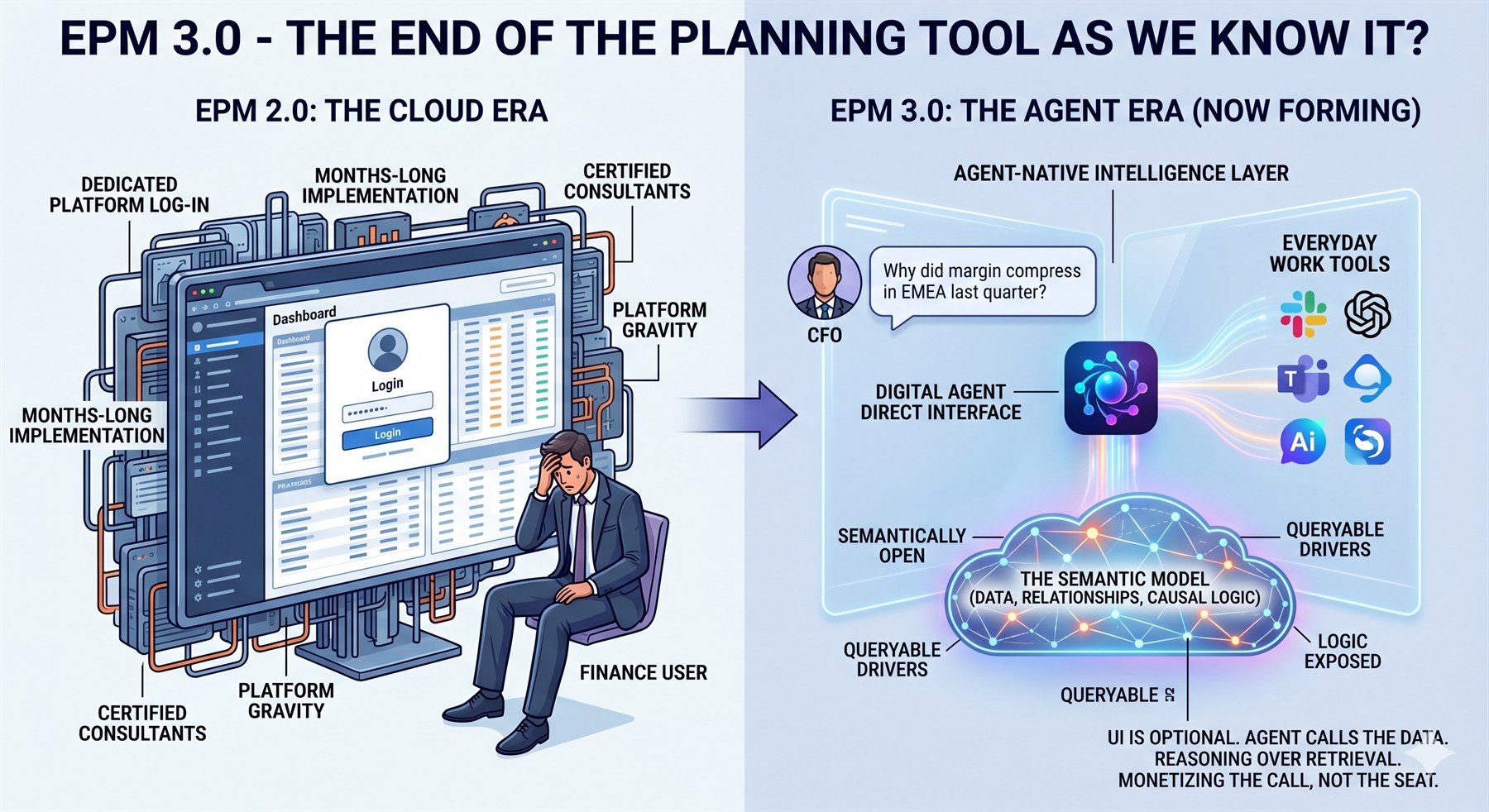
EPM 3.0. The end of the planning tool as we know it? Not the work. The category. Finance will still plan, forecast and model. But the dedicated platform you log into to do it? That's the shape of the last era, not the next one.
A short history
EPM 1.0: the IT era (1990–2010)
Hyperion, Adaytum, TM1, Cognos. Sold as control. Delivered concrete. Finance got a database; IT got the keys (except for Adaytum).
EPM 2.0: the cloud era (2010–2025)
Anaplan broke through; OneStream extended it; newer entrants are raising hundreds of millions to scale the same architectural idea. Sold as agility. Delivering, increasingly, platform gravity, months-long implementations, Centres of Excellence, certified consultants. Finance traded one bureaucracy for another.
EPM 3.0: the agent era
The third era is now forming, and here is the question that breaks 2.0.
If the CFO of 2028 asks "why did margin compress in EMEA last quarter?", where do they ask it?
Not in a planning tool. They'll ask wherever they already work: phone, voice, Teams, Slack, an AI assistant. That's already how senior people work with information that isn't trapped in some platform's UI.
When that question arrives, something has to answer. The agent is an interface, not knowledge. The answer is whatever the agent calls: the data, the relationships between drivers, the semantic model.
That layer is EPM 3.0.
Three properties define it
Agent-native, not agent-friendly
The primary consumer is no longer a human clicking. It's an agent calling. The UI becomes optional.
Semantically open
Drivers, relationships and causal logic: all queryable through a stable, documented interface. Agents reason; they don't just retrieve.
Infrastructure, not destination
Vendors stop monetising the seat and start monetising the call.
The copilot trap
EPM 2.0 incumbents will add "AI copilots" to their existing UIs and call it the future. It is not.
A copilot bolted onto a destination is still a destination.
The architectural commitments that made them great in 2.0 (seat-based pricing, the platform as place) are exactly what will hold them back.
The diligence questions for 2026
The diligence questions for buyers in 2026 are no longer "does it have AI features." They are:
- Can my own agents call this with the same depth as the vendor's agent?
- Is the model's logic exposed, or trapped inside the product?
- Am I buying a place my team logs into, or a layer my team's tools call?
Most current vendors fail these. They'll catch up partially, on a timeline that protects their existing revenue model. By then the category will have moved.
Finance teams will know the transition has happened when they realise they haven't opened a planning tool in months, and their forecasts have never been better.
Built for the agent era
A semantically open model your agents can call, not a destination you log into. That's the layer we're building with Novi. Join early access to follow the work.