From numbers to narrative: storytelling as a core function
A model can be perfect and still worth nothing, because it does not attend the board meeting. Someone has to stand between the numbers and the people who decide. On finance storytelling as a core function (the four questions, the one-page pack, the discipline of leaving things out, narrating the miss) and why AI drafts the story but must never hold the pen on the conclusion. Part 3, the finale of a short series on the FP&A department.
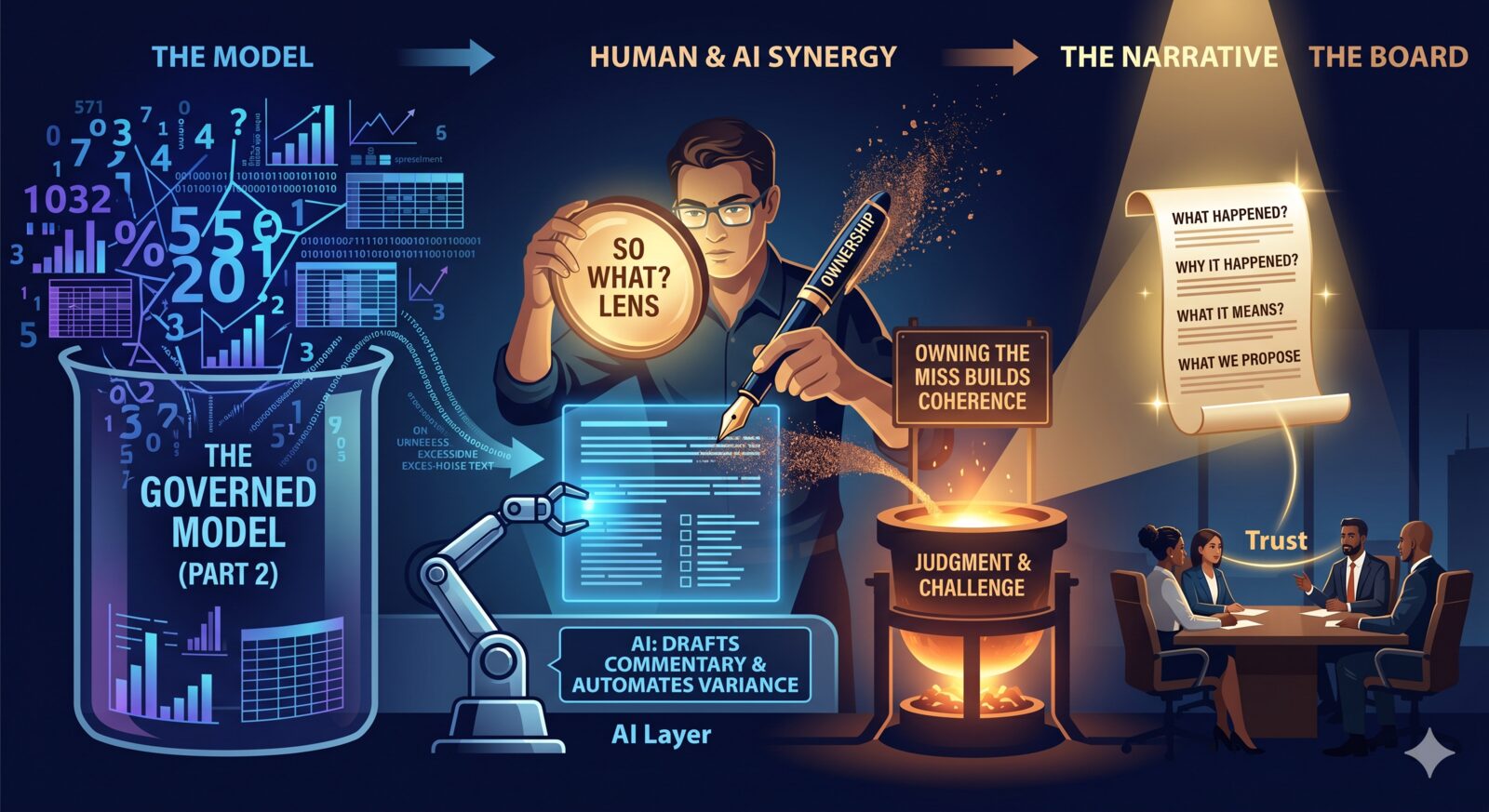
The model is built. It is governed, understood, alive: everything Part 2 asked of it. And it is still worth nothing, because a model has one fatal limitation that no amount of craft can fix: it does not attend the board meeting.
Someone has to. Someone has to stand between the model and the people who decide, and turn one into instructions for the other. After thirty years of sitting in those rooms (different industries, different sizes, different states of repair) I have come to a blunt conclusion: the FP&A professional who cannot narrate is doing half the job. The numbers that never became a story might as well never have been calculated.
This is the least technical post in the series, and the one I suspect will age best.
What the research actually says, and what it doesn't
Storytelling is a fashionable word, which means it has attracted fashionable claims. You have probably seen the one about stories being remembered "22 times better than facts." I would gently suggest not repeating numbers like that in a profession whose entire credibility rests on not repeating numbers like that.
The serious research is more useful than the slogan. Decades of communication studies comparing narrative and statistical evidence converge on something subtler: statistical evidence is at least as persuasive as stories, often more so, but narrative-driven attitude change persists longer, and narratives are measurably easier to process and remember. One line of research identifies the mechanism as processing fluency: information arranged as a story (situation, complication, resolution) is simply easier for a human mind to absorb than the same information arranged as a fact sheet.
Read that carefully and the implication for finance is not "tell stories instead of showing numbers." It is: the numbers persuade; the narrative makes them land and makes them stay. A board does not need to be charmed. It needs statistical evidence delivered in a structure a tired executive can absorb at 7am, retain through six other agenda items, and act on. That combination (rigour in the evidence, narrative in the delivery) is the controller's actual product. Either half without the other is either a bedtime story or a data dump.
What finance storytelling is, and is not
Let me be precise, because the word invites misunderstanding.
Finance storytelling is not decoration. It is not adding adjectives to a variance bridge, and it is emphatically not spin: the moment narrative is used to obscure rather than reveal, the navigator becomes something worse than the policeman from Part 1. It is also not a personality trait reserved for the naturally charismatic. It is a craft with an anatomy, and the anatomy is teachable.
Good variance commentary, the daily bread of the discipline, answers four questions in order:
What happened
The movement itself: the line the table already states in numbers.
Why it happened
The cause behind the movement: timing or trend, signal or noise.
What it means
The consequence: what the movement does to the full-year view.
What we propose
The decision: what, specifically, the room should do differently.
Most commentary I read stops after the first question, restating in words what the table already says in numbers. "Revenue was 4% below plan, driven by lower volumes in the industrial segment" is not commentary; it is a caption. Commentary begins where the caption ends: why were volumes lower, is it timing or trend, what does it do to the full-year view, and what, specifically, should the people in the room decide differently because of it.
The discipline behind all four questions is the so what test, and it is ruthless. Every paragraph in a board pack should survive the question "what would the reader do differently for having read this?" In my experience, applied honestly, that test removes about half of the typical pack, which brings me to the packs.
The board pack problem
Board packs grow. They never shrink on their own: every awkward question in history has left behind a permanent appendix, the way every Thursday in Part 2 left behind a patch. I have seen monthly packs north of a hundred pages, assembled with genuine effort by genuinely capable teams, and read by no one in their entirety, ever.
The hard truth about narrative is that it is mostly the discipline of leaving things out. A story is defined by what it omits; a pack that says everything says nothing in particular. The strongest finance teams I have worked with converge on the same structure: one page of narrative that a CEO could read alone in a taxi (what happened, why, what it means, what we propose) backed by appendices that exist to be consulted, not read. The page is the product. The appendices are the audit trail of the page.
Writing that one page is far harder than writing the hundred. It requires the author to commit to a view (this is what mattered this month, these are the two things that deserve your attention) and committing to a view is exposed work.
A hundred pages is a place to hide. One page is a position.
Which is exactly why it builds the thing the next section is about.
Narrative is a trust instrument
Here the threads of this series braid together.
In Part 1 I argued that a department perceived as the navigator gets told the truth, while a department perceived as the inspectorate gets fiction. Narrative is where that perception is built or destroyed, and it is built fastest in one specific situation: the miss.
Anyone can narrate a good month. The test of a finance storyteller is the bad one: the forecast that was wrong, the margin that slipped, the plan that is no longer achievable. The weak response is the passive-voice pack, "performance was impacted by market headwinds," which every executive correctly reads as the numbers hiding behind the weather. The strong response names the miss early, explains it plainly, separates what was knowable from what was not, and arrives with a proposal. I have watched careers built on a single well-narrated miss, because the room learned something more valuable than the number: that this person will tell us the truth when the truth is expensive.
That is why storytelling belongs in this series as a core function and not a soft skill. The mandate from Part 1, being the place where the organisation is forced to be coherent, is exercised through narrative or not at all. Coherence is a story property. Spreadsheets do not cohere; accounts of them do.
And AI?
The closing question of the series, taken at full length this time, because narrative is where AI's arrival is most visible, most useful, and most quietly dangerous.
Start with the observable fact: surveys of the profession find that where generative AI has entered FP&A at all, it has entered here first: narrative reporting, first-draft commentary, the writing layer. That makes economic sense. Drafting is exactly the kind of work these systems do well: a competent first pass at variance commentary, consistency between figures and text, a clean summary of a long pack. The blank page, which has eaten countless analyst evenings, is essentially gone. Good riddance.
So the compression is real, and across the whole series the pattern is now visible. What compresses: data gathering and process administration (the 75% from Part 1), model construction (Part 2), and first-draft narrative (this post). What expands: everything that was always scarce: the stewardship of models that Part 2 ended on, and the judgement, the challenge, and the ownership of the story that this post is about.
But narrative carries a risk the other two posts did not have to flag, and I want to state it plainly. The commentary is not a writing task that happens to involve judgement. It is a judgement task that happens to involve writing. When a system drafts your variance commentary, it produces the most plausible account of the numbers, and the most plausible account is precisely what a good controller is paid to challenge. Plausible is the default. Insight is the deviation from it: the timing effect the draft mistook for a trend, the offsetting errors the draft read as stability, the thing that should have happened and didn't, which no draft will flag because absence leaves no trace in the data.
So the rule I would give any team adopting these tools is short:
Let AI write the first draft; never let it hold the pen on the conclusion. The draft is leverage. The signature is the job.
A department that forwards machine-written commentary unchallenged has not automated its storytelling. It has resigned from it, and the room will notice within two quarters, the same way it always notices when the person presenting the numbers does not actually hold a view.
The department, a few years out
Put the three posts together and the FP&A department of the near future comes into focus, and it is (I say this as someone constitutionally suspicious of futurology) a genuinely good place to work.
The mandate has not moved an inch: the forward view, and the place where the organisation is forced to be coherent. What has moved is the weight distribution under it. The data-plumbing layer that consumed three-quarters of the profession's week is shrinking, decade-overdue. What fills the space is the work the function was always supposed to be: stewarding models that stay understood while changing faster than ever, and standing in front of the people who decide, with rigour in the evidence, narrative in the delivery, and a view of their own.
A department like that is smaller in administration and larger in consequence. It is harder to staff, because the scarce skills were always the human ones, and easier to respect, because its product is visible in every decision it touched. The professionals who thrive in it will be the ones who treated the tools as leverage on the craft rather than a replacement for it, who kept ownership of the understanding and the conclusion while everything around those two things accelerated.
The function spent decades being described as the back office of the back office. I have watched it from close range for thirty years, and I don't think that description was ever fair. It is about to become obviously untrue.
This concludes the series. Part 1: the mandate, the shapes, and the roles. Part 2: building models and keeping them alive. Comments and disagreements are welcome; the disagreements are usually where I learn something.
- Allen & Preiss, Comparing the Persuasiveness of Narrative and Statistical Evidence Using Meta-Analysis; Kazoleas, A comparison of the persuasive effectiveness of qualitative versus quantitative evidence: relative persuasiveness and persistence of narrative vs. statistical evidence
- Bullock, Shulman & Huskey, Narratives are Persuasive Because They are Easier to Understand (Frontiers in Communication, 2021): processing fluency; narratives easier to read and remember (citing Graesser et al., 1980)
- Han & Fink, How Do Statistical and Narrative Evidence Affect Persuasion? (Argumentation and Advocacy): vividness vs. amount of evidence
- FP&A Trends Group / industry surveys 2025: generative AI adoption concentrated in narrative reporting and automation (fpa-trends.com)
Rigour in the evidence. Narrative in the delivery.
Novi is built for the department this series describes: a model finance owns and a machine can read, so the first draft of the story is automatic and the judgement stays yours.