What is an FP&A department actually for?
Accounting records what happened; FP&A argues about what should happen next. Thirty years alongside finance departments, written down honestly: the mandate, what the function is not, the three shapes a department takes, and the role that never appears on the org chart. Part 1 of a short series on the FP&A department.
I have spent over thirty years working with finance departments, and more than twenty of those working with FP&A solutions: different industries, different sizes, different states of repair. There is something I keep repeating to younger colleagues: it is the width of the horizon that gives you experience, and the distance. A person who runs one FP&A department sees one department, deeply. Stand next to dozens of them, across enough years, and the patterns stop being anecdotes.
In that time I have also read a great many descriptions of what the function is supposed to do, most of them written by people who had clearly never watched a Tuesday afternoon in month-end week. Very few of those descriptions survive contact with one.
So this series is an attempt to write the thing down honestly: what an FP&A department (call it Controlling, call it FP&A, it is the same discipline wearing a different badge) actually exists to do, how it tends to be organised, what the daily craft really is, and what artificial intelligence genuinely changes about all of it. Three posts. This first one is about mandate, shape, and roles.
The mandate: the future, with numbers attached
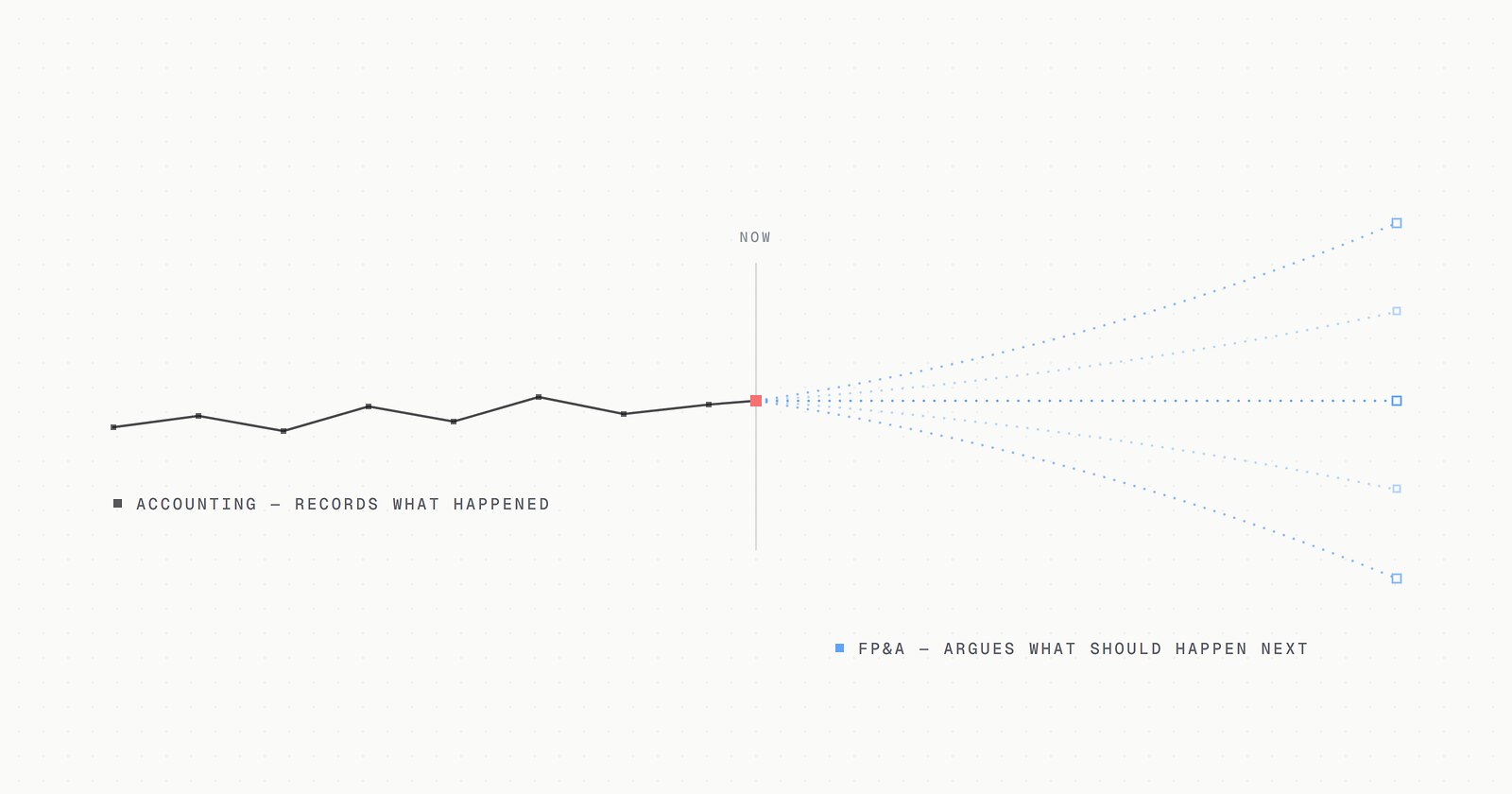
The simplest honest definition I can offer: accounting records what happened; FP&A argues about what should happen next.
Accounting is the discipline of the past: precise, governed, auditable, and necessarily backward-looking. FP&A is the discipline of the forward view: budgets, forecasts, scenarios, the bridge between what the business intends and what the numbers say is plausible. The confusion between the two is still remarkably common, partly because in smaller companies the same people do both, and partly because both produce reports and to an outsider a report is a report.
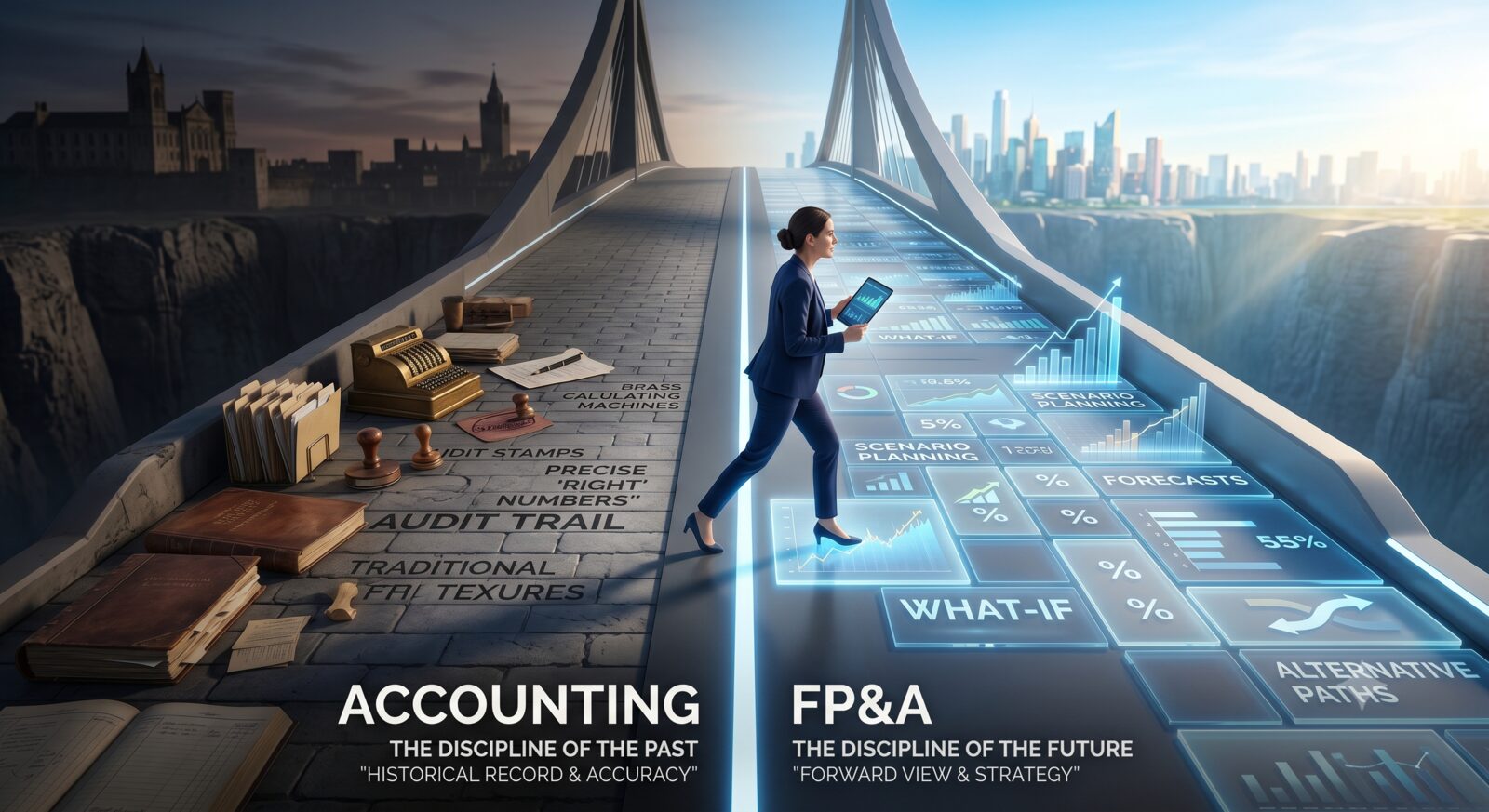
But the difference in mandate is fundamental. An accountant is judged on whether the numbers are right. An FP&A professional is judged on whether the numbers are useful: whether they arrived in time to shape a decision, whether the assumptions behind them were the right assumptions to argue about, whether anyone in the room changed their mind because of them. A perfectly accurate forecast delivered the week after the decision was made is worth nothing. I have watched a few of those land on desks. Nobody framed them.
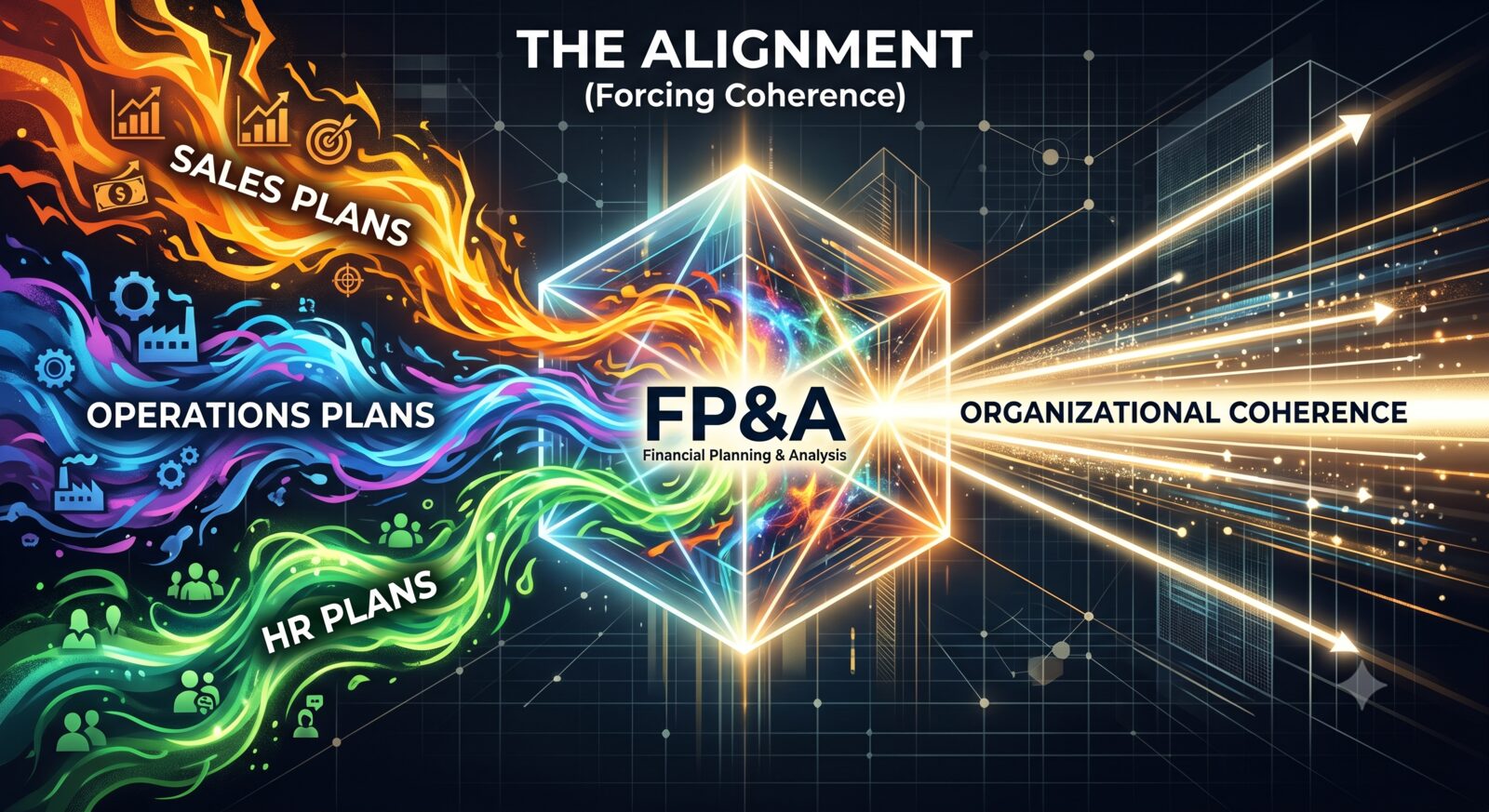
There is a second part of the mandate that rarely appears in job descriptions but is, in my experience, the most valuable thing the department does: FP&A is the place where the organisation is forced to be coherent. Sales has a plan, operations has a plan, HR has a plan, and the planning process is where those plans are made to confront each other and the cash they collectively require. The numbers are almost a by-product. The alignment is the product.
The research suggests most organisations are still far from this. The FP&A Trends Survey, nearly three thousand finance professionals, found that only 11% of organisations have fully aligned their strategic, financial and operational planning, and only 17% would describe their own data quality as good. If you have ever wondered whether your department's struggles are unusual: they are not. They are the norm, measured.
What an FP&A department is not
Having said what the department is for, it is worth being equally plain about what it is not, because I have watched these misunderstandings consume entire teams.
It is not an invoice verification department. Checking invoices, validating purchase orders, chasing approvals: that is accounts payable work, and it belongs there. Yet in many organisations the FP&A team gets pulled into transactional verification, usually because they are the nearest people who "understand the numbers." Every hour spent confirming that an invoice matches a PO is an hour taken from the forward view, and the forward view is the entire mandate.
It is not an internal audit department. Audit provides assurance about the past: were the controls followed, were the rules respected, is the record trustworthy. Essential work, and a fundamentally different posture. Audit examines; FP&A steers. An audit function must keep professional distance from the business. An FP&A function that keeps distance from the business is useless.
Part of the confusion is linguistic, and it runs deep. In some cultures and languages, the word behind Controlling is heard as to check, to inspect, to watch, and so the department gets read as the corporate inspection service. But the relevant sense of control is the pilot's, not the policeman's: a pilot has control of the aircraft. They are not auditing it mid-flight; they are steering it. That is the true meaning of having control over things (knowing where you are, where you are heading, and what to adjust) and it is the meaning the function was built around.

The distinction is not academic. A department perceived as the inspectorate stops receiving honest information: sales pads the pipeline, operations hides the risk, and the forecast quietly becomes fiction reviewed by police. A department perceived as the navigator gets told the truth, because people confide in the person helping them steer. Which of the two your FP&A team is perceived as will do more for forecast accuracy than any system you buy.
The mandate versus the Tuesday afternoon
Here is the uncomfortable benchmark, and the reason this series exists.
A joint study by the Association for Financial Professionals and APQC surveyed over four hundred FP&A professionals about where their time actually goes. The answer: roughly a quarter on analysis. The rest, three quarters, on gathering data and administering processes.
The detail that should give every finance leader pause is this: when APQC compared that figure with the same question asked back in 2010, it had improved by two percentage points. Two. A decade and a half of finance transformation programmes, new platforms, dashboards, and conference keynotes, and the analyst's week looks almost exactly the way it did when the iPhone 4 was new.
I recognise that number, because I have watched it from up close for two decades, usually while implementing the very systems that were supposed to fix it. The pattern repeats across companies that otherwise have nothing in common: a department hired for its analytical judgement, spending its week as a data-logistics operation with an analysis hobby. Nobody plans it that way. It accretes: one more source system, one more reconciliation, one more "temporary" spreadsheet that turns seven.
The point is not despair. The point is that the mandate and the work have drifted apart, and any honest conversation about organising an FP&A department has to start from that fact rather than from the org chart we wish we had.
How should an FP&A department be organised?
There are, in practice, three shapes. Every variation I have encountered is one of these wearing a costume.
The centralised team. One department, usually reporting to the CFO, serving the whole organisation. Strengths: consistency, a single version of the truth, deep methodological craft, efficient use of scarce skills. Weakness: distance. A centralised team can become a reporting factory: technically excellent, commercially deaf, producing analysis about a business it rarely touches.
The business-partner model. Analysts embedded in business units (a finance partner for sales, one for operations, one per region or product line) with a thin central spine for consolidation and standards. Strengths: proximity, relevance, trust; the partner knows why the number moved before the number arrives. Weakness: fragmentation. Each partner gradually develops their own definitions, their own files, their own version of gross margin, and consolidation becomes archaeology.
The hybrid. A central team that owns methodology, definitions, systems and the consolidated view, with partners embedded in the business who own the relationship and the local plan. This is where most organisations above a certain size end up, and in my experience it is the right destination, provided the centre genuinely owns the common language. A hybrid without shared definitions is just the business-partner model with extra meetings.
The honest observation from experience: structure follows trust, not theory. Organisations centralise when they have been burned by inconsistency, and decentralise when they have been burned by irrelevance. Most FP&A org charts are scar tissue. The useful question is not "which model is best" but "which failure are we currently correcting for, and what will we over-correct into next."
Size matters too, and it is worth being plain about thresholds. Below roughly 200 employees, FP&A is usually one or two people doing everything, organisational models be damned. The interesting design questions begin in the mid-market: large enough that one person cannot hold the whole model in their head, small enough that a few bad planning decisions are existential. That is also, not coincidentally, where a well-run department earns its keep most visibly.
The roles: who actually works in FP&A?
Titles vary wildly across companies and geographies, but the underlying roles are stable. A reasonably complete department contains:
The head of FP&A (or head of Controlling, same chair). Owns the planning calendar, the methodology, the relationship with the CFO and the board pack. The job is two-thirds translation: turning executive intent into modelling assumptions on the way down, and turning model output into decisions on the way up.
Business partners / senior analysts. The embedded layer described above. The defining skill is not technical: it is the ability to be trusted by an operations director who has met many finance people and liked few of them.
Analysts. The engine room: forecast updates, variance analysis, the monthly pack, the model maintenance nobody thanks them for. This is where careers begin and, frankly, where the 75%-data-plumbing problem lives most acutely.
Specialised controllers, where scale justifies them: a sales controller who owns pipeline-to-revenue logic, a production or operations controller who owns cost and capacity, a group controller who owns consolidation across entities. Each is a deep vertical of the same craft.
The model owner. Here is the role I want to flag, because it is the one most often missing from the org chart while being present in reality: in every FP&A department there is one person who actually understands how the model works. Not the official owner, the real one. The person everyone goes to when the bridge doesn't bridge. This role is almost never named, never budgeted, never succession-planned, and its departure is the single most common cause of a planning model quietly dying. The next post in this series is largely about that person.
One more research note worth sitting with: APQC found that nearly 80% of organisations name data management as a top skill they need in FP&A, and that the skill remains uncommon among FP&A talent. The market is telling us something about what the job has become, whether or not the job descriptions have caught up.
Where should FP&A report?
Briefly, because the answer is short: to the CFO, with a direct line of sight, not buried under the chief accountant. The reporting line is a statement about mandate. A department that reports through accounting will be treated as an extension of accounting, and will gradually become one: backward-looking, compliance-toned, asked for reports rather than opinions. I have watched this happen. It takes about two budget cycles.
And AI?
Each post in this series ends with the same question, examined from that post's angle.
For department organisation, the honest answer is: AI does not change the mandate at all. It changes which roles spend their time on what, and it does so unevenly.
The 75% of time spent gathering data and administering process is precisely the territory AI and automation eat first. That is genuinely good news, with a sting in it: if the data-plumbing layer of the analyst role shrinks, the traditional career ladder (start in the engine room, learn the business by wrestling its data) shrinks with it. Departments will need to think deliberately about how junior people learn the business when the apprenticeship work is automated. Meanwhile the skills that were always scarce (judgement, narrative, the trust of the operations director) become the whole job rather than the reward for surviving the plumbing.
The adoption numbers say we are early: as of last year, around 18% of organisations were using generative AI in FP&A, mostly for narrative and reporting tasks, and only 8% were using machine learning for forecasting. Early, but the direction is not ambiguous.
What AI means for the craft, for building and maintaining the models themselves, deserves its own post. That is Part 2: who builds the model, who owns it, why models decay, and why the person from the org-chart footnote above matters more than anyone's title suggests.
Part 2 ("The craft: building models, and keeping them alive") is now live.
- AFP / APQC, FP&A Benchmarking Survey: time allocation across data gathering, process administration, and analysis (apqc.org)
- FP&A Trends Group, FP&A Trends Survey 2025: planning integration, driver-based modelling, and data quality benchmarks (fpa-trends.com)
- APQC, Data-Driven Transformation in FP&A: skills demand and AI adoption (apqc.org)
Built for the forward view
Novi is a modelling platform for the department this series describes: the forward view, owned by finance, with the data logistics taken off the analyst's desk.