The AI Phase Change
Part five of the Agile Finance series. The productivity story about AI in finance is true, and small. The real phase change is the collapse of the model-comprehension bottleneck: an agent that understands the model as financial semantics turns "convene three analysts and a controller" into "ask a question."
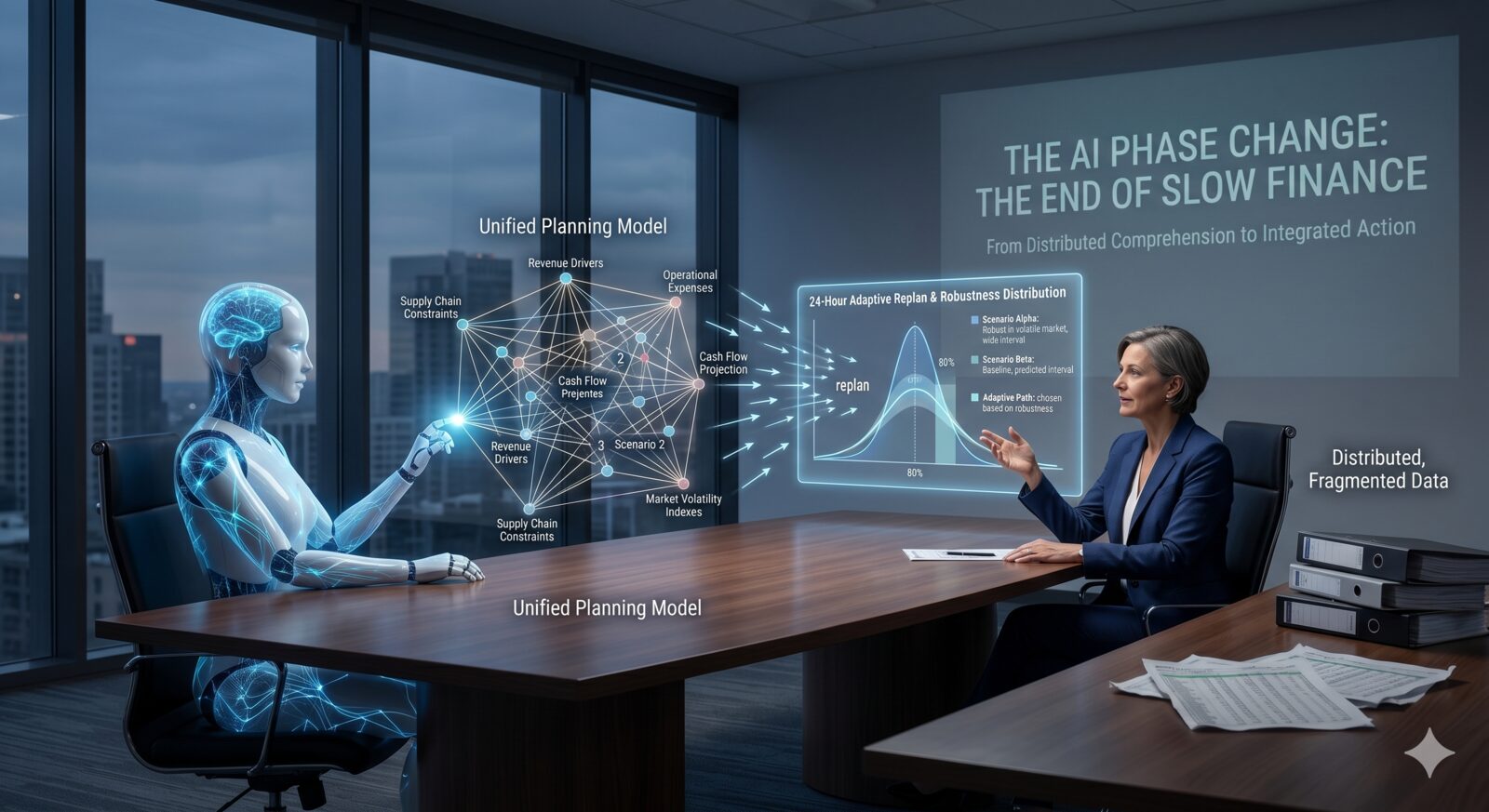
The story being sold about AI in finance is true. It is also small.
This is the part of our ongoing conversation that has most divided us, and I've come to a clearer view through it.
Yes, AI will do all of this, and all of it is real, already happening, and a genuine productivity gain:
- Automate variance analysis.
- Draft commentary.
- Speed up reconciliations.
- Pre-write board materials.
None of it, on its own, is an agility gain.
The comprehension bottleneck
The genuine contribution of AI to finance (the one that will look, in retrospect, like a phase change) is different. It is the collapse of the model-comprehension bottleneck.
Here's the deepest reason most finance functions cannot replan in 24 hours: no single human can hold the entire planning model in their head. Not the senior analyst. Not the controller. Not the CFO.
So any non-trivial replan requires a meeting. Meetings require calendars. Calendars take a week.
Not the systems. The fact that comprehension is distributed across humans who must be convened to act.
An AI agent that genuinely understands the planning model (not as data, but as financial semantics) turns "I need to convene three analysts and a controller" into "I need to ask a question."
That is not automation. That is a different operating model.
When scenarios become free
There's a second contribution that gets less airtime. When scenarios become free to run, the entire epistemology of planning shifts.
The old question
What is the number?
The new question
Across the distribution of plausible worlds, where do we want to be robust?
That's a much more agile posture. It requires a finance culture comfortable saying "our central case is X, our 80% interval is Y to Z", instead of pretending to predict the future.
The prerequisite
The implication for finance leaders is sharper than the productivity narrative suggests. The value of AI in finance will be captured by organisations whose planning models are coherent enough for AI to understand.
Those with fragmented, undocumented, spreadsheet-anchored architectures will find that AI accelerates their existing problems rather than solving them.
The prerequisite is not the model. It is the semantic clarity of the model.
That is the work that begins now.
A model an agent can read
Financial semantics an agent can actually understand, so a replan is a question, not a convening. Semantic clarity is the prerequisite, and it's what we're building into Novi. Join early access to follow the series and the work.