The Benchmark Lie
Part four of the Agile Finance series. Days-to-close, APQC, Hackett, FTE-per-billion-revenue: the benchmarks our profession lives by measure what's easy to count, not what's hard to do. The one worth using is internal, dynamic, and far harder to game.
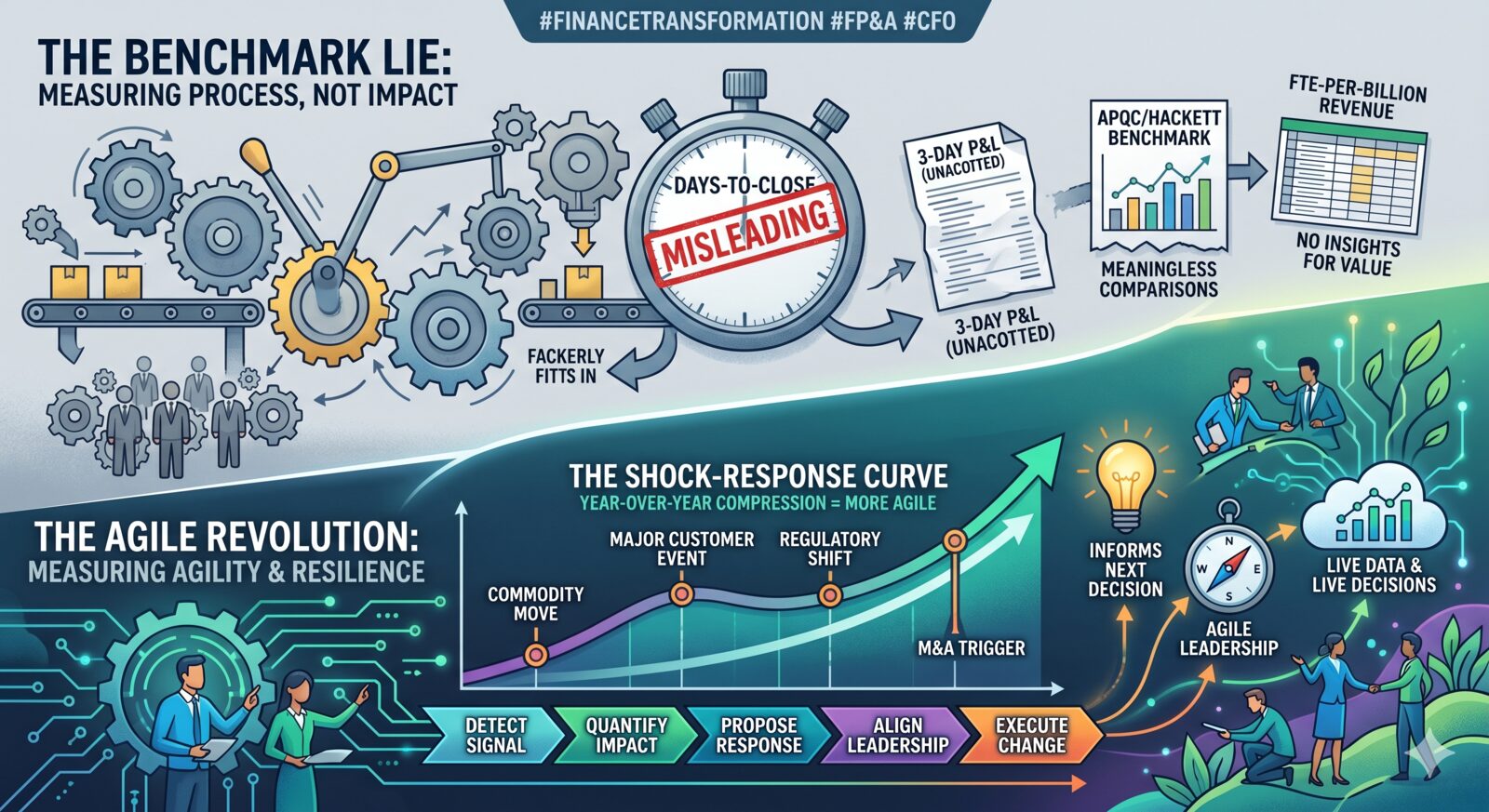
Days-to-close is one of the most misleading metrics in modern finance.
Not wrong. Misleading.
It tells you something about process discipline. It tells you almost nothing about whether the close actually informs the next decision.
A 3-day close
…that produces a P&L nobody acts on.
A 7-day close
…that lands with full variance commentary in the CEO's hands, ready for a Monday allocation meeting.
The second one is more agile. By a wide margin.
Comparability without insight
The same applies to most public benchmarks in our profession. APQC, Hackett, FTE-per-billion-revenue. These measure what is easy to count, not what is hard to do.
They produce comparability without insight.
The shock-response curve
The benchmark we'd actually recommend is internal, dynamic, and harder to game: the shock-response curve.
Pick three or four exogenous events from the last 24 months: a commodity move, a major customer event, a regulatory shift, an M&A trigger. For each one, measure how long it took finance to:
Detect the signal
From the moment the event happened to the moment finance noticed it.
Quantify the impact
Translate the event into a number the business can reason about.
Propose a response
Turn the impact into a credible course of action.
Align leadership
Get the people who decide to agree on the move.
Execute the change
Make it real in the plan and in the business.
If the curve compresses year-over-year, you are getting more agile.
If it doesn't, your technology investment is just paint on rust.
The benchmarks worth studying
The closest external benchmarks worth studying are the digital natives that grew up planning in real time. Stripe-era companies. Some of the better-run alternative asset managers. Not because their processes transfer (they don't) but because they show what's possible when the function is built from scratch around live data and live decisions.
The honest answer for most enterprises is that they will never benchmark to those companies. Their data architecture won't support it.
That isn't a reason not to measure. It's a reason to stop measuring the wrong things.
Measure what's hard to do
Detect, quantify, propose, align, execute: a shock-response curve that compresses every year because the model and the data underneath it are built for it. That's what we're building toward with Novi. Join early access to follow the series and the work.