Three building blocks: the DNA of every financial model
Every financial model ever built, from a one-page budget to a multinational consolidation, comes down to three components. Here's the whole alphabet.
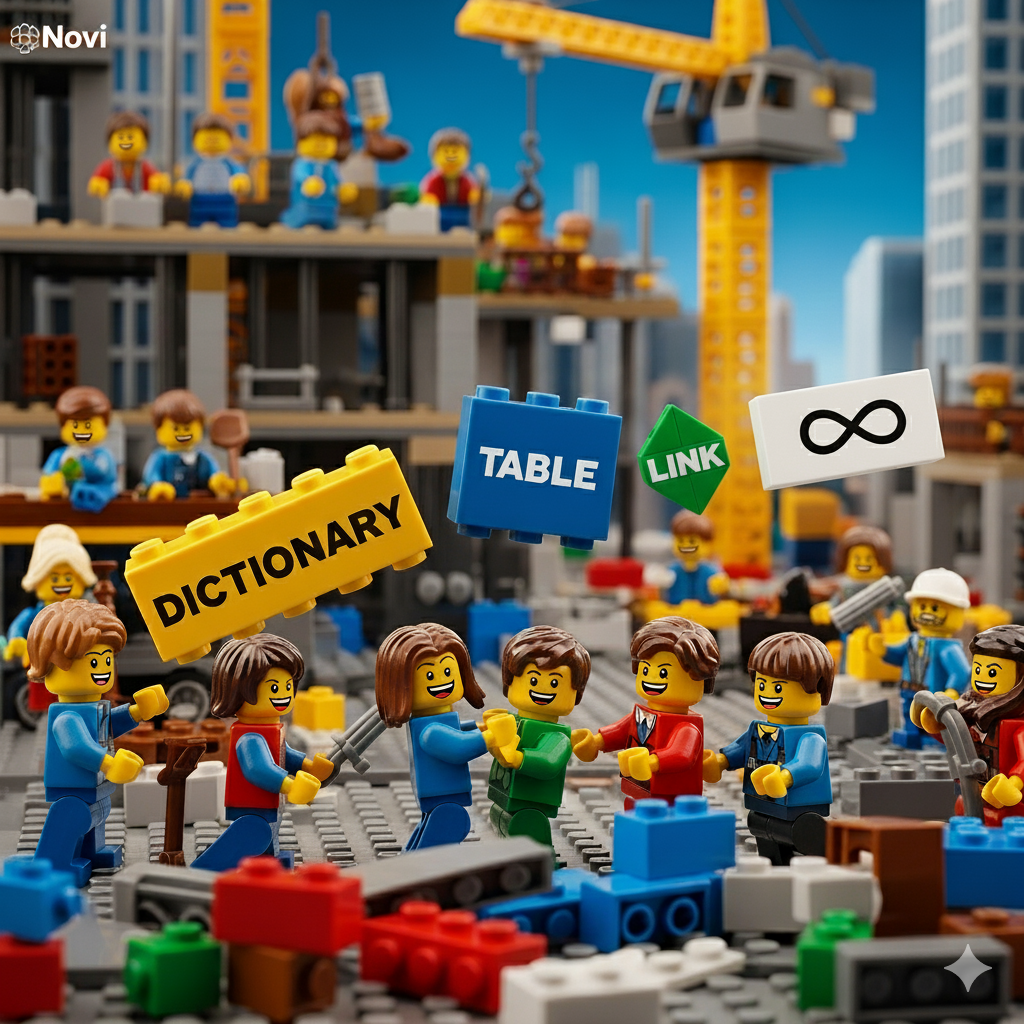
What if every financial model ever created, from a simple budget to the most complex multinational consolidation, is built from just three fundamental components?
We didn't stumble onto this. We reverse-engineered thousands of financial models, stripped away the complexity that vendors love to sell, and found something profound: simplicity is not a limitation. It's a superpower.
The three building blocks
D: Dictionaries
Your business vocabulary and calculation formulas. This is where you define what "Revenue," "EBITDA," or "Customer Acquisition Cost" means for your business.
Think of it as your company's financial language: standardised, clear, and reusable across all models.
T: Tables
Where your data lives. Multi-dimensional, lightning-fast, and infinitely scalable. No more sprawling Excel tabs or database nightmares.
Handle millions of data points across products, regions, and time periods, all in real time.
L: Links
The intelligence layer. Links connect everything: pulling data from sources, connecting calculations, triggering workflows. This is where logic becomes alive.
No SQL. No scripts. Just point, click, and connect.
We believe powerful doesn't have to mean complicated. While the industry trend has been toward more features, more functions, more complexity, we chose a different path: radical simplification.
At Novi we only have three building blocks. That's it. And they can do everything those complex systems can do, faster, simpler, and without an army of consultants.
The three layers of FP&A
But building blocks are just the beginning. Every successful FP&A process operates on three fundamental layers:
Model Layer
The logic, calculations, and data structure. This is your business brain, where assumptions meet reality and scenarios come to life.
Data Collection Layer
There are two important factors in data collection for FP&A: A) human contributors in the planning and reporting process: Contribution; and B) automated data flows from system sources, ERPs, CRMs, databases, APIs, even those Excel files from sales: Integration. No more manual copy-paste marathons.
Storytelling Layer
The "A" in FP&A. AI-supported insights that find the story in your numbers. Cause-and-effect analysis, anomaly detection, and narrative generation that makes CFOs look like heroes.
Why simplicity wins
Leonardo da Vinci said, "Simplicity is the ultimate sophistication." We live by this.
| The old way | The Novi way |
|---|---|
| 6–18 month implementations | Days to first model |
| Requires certified consultants | Finance teams own it completely |
| 100+ functions to learn | 3 building blocks to master |
| Black box calculations | Transparent, traceable logic |
| IT dependency for changes | Click and modify yourself |
Real power in practice
Let's be concrete. Here's what you can build with just D + T + L:
- Multi-entity consolidation across 50 subsidiaries with automatic FX conversion? ✓
- Driver-based planning with 200 operational drivers updating in real time? ✓
- Rolling forecasts that automatically shift periods without rebuilding? ✓
- Scenario modelling with unlimited what-if versions? ✓
- Allocations and eliminations that actually make sense? ✓
And here's the kicker: you can understand how it all works. No mysterious black boxes. No "that's just how the system does it" explanations. Just clear, logical connections you can see, modify, and trust.
We've seen companies spend $2 million and 18 months implementing enterprise FP&A tools, only to export everything back to Excel because no one understands how to modify the models. With Novi, if you can use Excel, you can build and modify enterprise-grade models.
The philosophy behind the simplicity
This isn't simplicity for simplicity's sake. It's simplicity with a purpose:
Dictionaries force clarity. When you define "Customer Lifetime Value," everyone in your organisation uses the same definition. No more arguments in board meetings about whose numbers are "right."
Tables enforce structure. Multi-dimensional from day one means you never hit the Excel wall where adding a new dimension means rebuilding everything.
Links ensure agility. When business logic changes (and it always does), you reconnect links, not rewrite code.
The bottom line
Every other vendor is in an arms race of complexity. More features. More functions. More certifications. More consultants.
We're running the opposite race. How simple can we make this while still solving every FP&A challenge? How can we give finance teams their power back?
Three building blocks. Three layers. Infinite possibilities.
That's not a compromise. That's a revolution.
Want to help build it?
Novi is being built in the open. Join early access to follow the work, and to shape the platform while it's still taking shape.