The fire drill always wins
Every finance team keeps two calendars, and the one with no dates on it wins almost every time. Part of that firefighting is the permanent nature of the job. A good deal of it is not the question's fault but the model's, and that part can be cured.
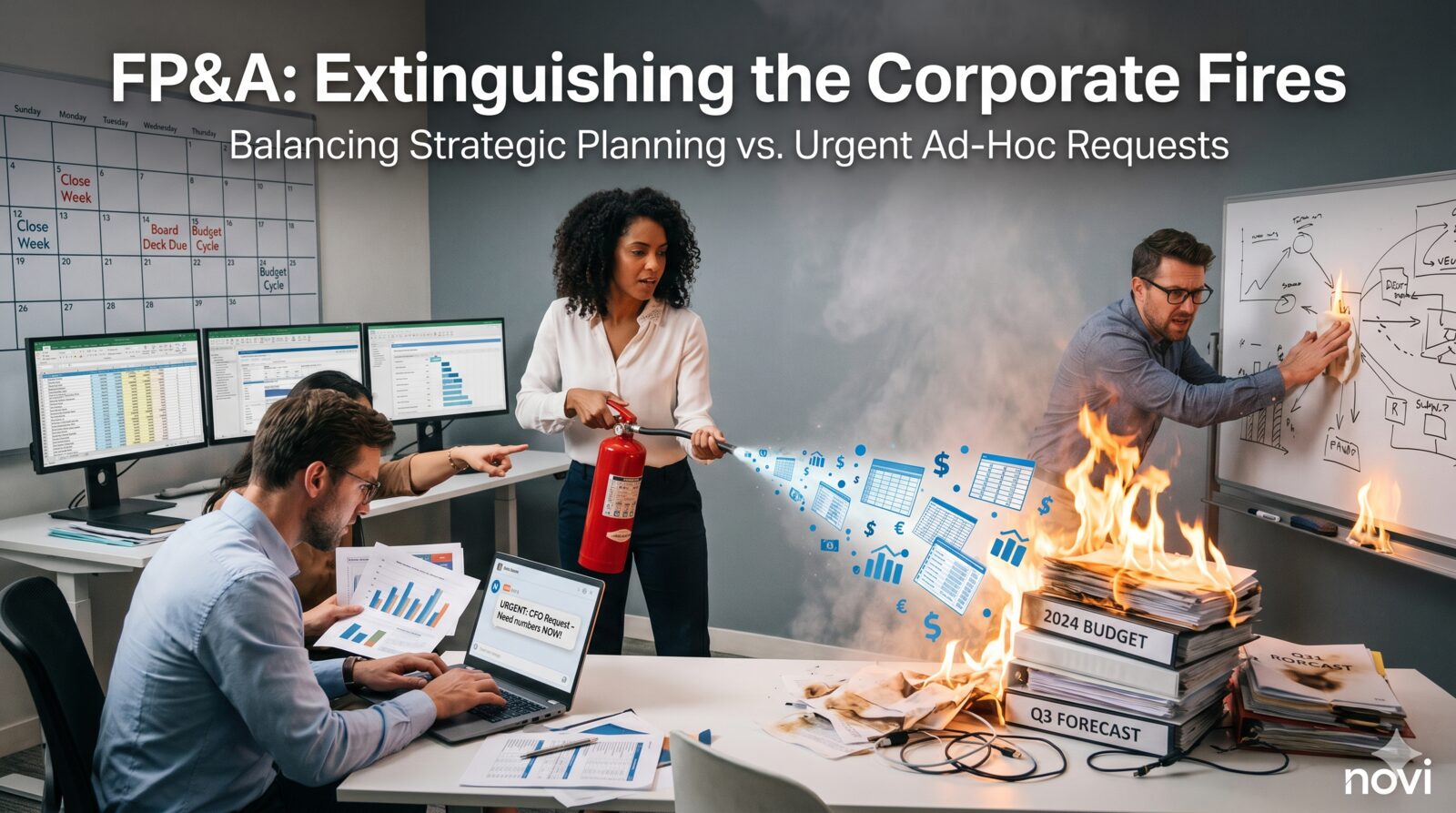
Every finance team keeps two calendars. There is the one on the wall: the close, the forecast, the budget, the board pack, all arriving on dates everyone agreed to months ago. And there is the other one, which has no dates on it at all: the question from the CFO at half past four, the investor who needs a number by morning, the sales leader who has just promised a customer something the model didn't know about.
The second calendar wins almost every time. It wins because it has a face attached to it. Someone is waiting. The scheduled work, meanwhile, sits patiently with its deadline weeks away, and patience is the one quality that gets a task deferred. So the forecast waits while the fire is put out, and by the time the forecast comes back around, there is another fire.
The fire that never goes out
It would be easy to conclude that this is simply the nature of the job, and part of it is. Finance sits at the point where every decision in the business gets turned into a number, and the business does not schedule its uncertainty. A hire, a price change, a delayed shipment, a board member's curiosity: none of these consult the planning calendar before they arrive. That portion of the firefighting is permanent, and no tool will remove it.
But a good deal of the firefighting is not the question's fault. It is the model's.
When the fire is the model's fault
When a forecast lives as a sprawl of spreadsheets (logic, data, and presentation all tangled in the same cells) every new question turns into a small demolition job. What happens if we push the German hire to Q3 ought to take a few minutes to answer. Instead it means finding the right tab, tracing the dependencies, breaking something, fixing it, and rebuilding the summary by hand. The request stops being a quick reply and becomes a project. And because each request is a project, the team never gets ahead; it is always rebuilding the thing it just finished rebuilding.
The first is permanent. The business does not schedule its uncertainty: a hire, a price change, a board member's curiosity arrive whenever they arrive. Answering them is the job, and no tool removes it.
The second is manufactured. A quick question becomes a demolition job only because the model makes it one. This fire we lit ourselves, and it is the one that can go out.
Why budgeting takes three months
This is also, quietly, why budgeting takes three months. The thinking inside a budget is not slow. Most of the real decisions could be made in a fortnight. What is slow is everything that happens after a number changes: the consolidation redone by hand, the version reconciled, the deck rebuilt, the circulation, and then the next change arrives and it all begins again. The negotiation is not the bottleneck. The plumbing is.
What can actually change
So, can any of this be cured? Honestly, not all of it. The questions will keep coming, and they should. Answering them is the job. What can change is the cost of answering. When a model is built so that logic and data are kept separate, and a single change flows through everything downstream on its own, a new question becomes a quick reply again rather than a project. The fire drill becomes ordinary. And budgeting, freed from its manual recompute, collapses toward the time it actually takes to make the decisions: days, not months.
Where the fire rarely starts
This is most of what we think about at Novi. Not how to make finance work harder during the fire, but how to build models where the fire rarely starts, where a question is something you answer before lunch, and the calendar on the wall finally gets the time it was promised.
Models where the fire rarely starts
Novi is a modelling platform for finance: logic and data kept separate, a change that flows through everything downstream on its own, and a question you can answer before lunch. A model finance owns, and a machine can read.