What exactly is a financial model?
An attempt to describe a real business with arithmetic: what a model actually is, why it is always a little bit wrong on purpose, how it differs from the systems that merely record, and the families of model you meet in a working finance life.
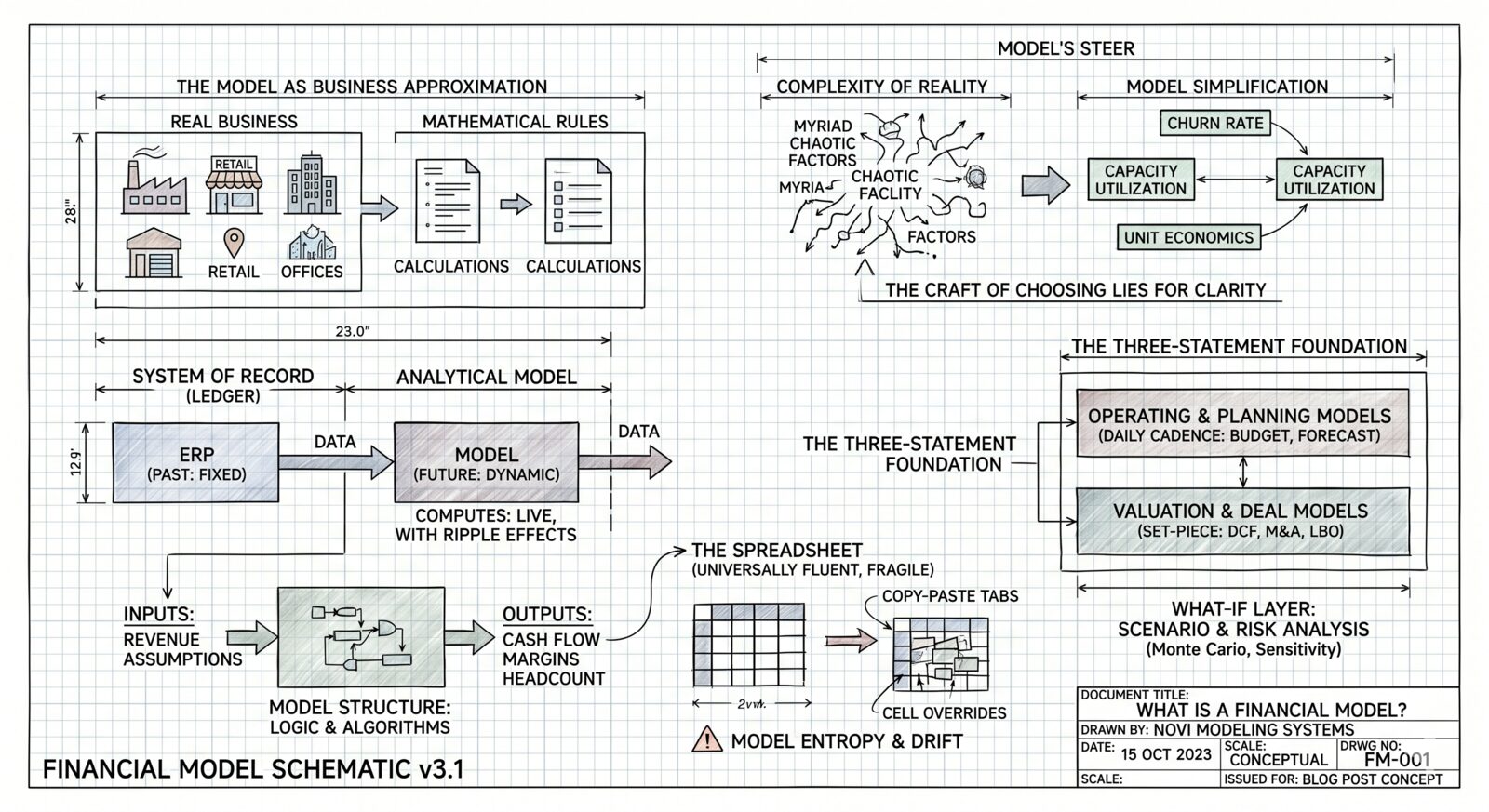
Ask ten finance people what a financial model is and you will get ten answers, most of them gesturing at a spreadsheet. That is fair enough. But it is worth being precise, because the precision turns out to matter.
A financial model is an attempt to describe an actual business using mathematical rules. More plainly: it is a set of data and a set of calculations (formulas, logic, sometimes algorithms) assembled so that, together, they reproduce how a real business behaves. Put revenue assumptions in one end; out the other come margins, cash, headcount cost, the shape of next year. Change an input and the whole structure responds, the way the business would.
That is the whole idea. A model is a business, rendered in numbers, small enough to hold in your head and fast enough to ask questions of.
If your child asks: it's a pretend version of a company, made out of numbers, so you can ask "what if?" without trying it for real.
If your boss asks: it's where our assumptions about the business turn into the numbers they would produce, so we can test a decision before we commit to it.
A model is an approximation, and that is the point
Here is the first thing worth saying clearly, because a surprising amount of grief comes from forgetting it: a model is always an approximation. Only ever an approximation.
A model that reproduced a business perfectly, in every detail, would not be a model. It would be the business. The usefulness comes precisely from what gets left out. You decide that customer churn can be one rate rather than ten thousand individual decisions; that a factory's output can be a function of three drivers rather than three hundred. Every one of those choices is a simplification, and every simplification is a small, deliberate lie told in service of clarity.
The craft of modelling is mostly the craft of choosing which lies to tell.
Leave out too much and the model is tidy but wrong. Leave in too much and it is accurate, unreadable, and impossible to maintain. Good modellers develop a feel for the line. It is closer to drawing a map than taking a photograph. A map is useful because it omits almost everything.
Which leads to the second thing: because the world keeps moving, the map needs redrawing. Markets shift, the business reorganises, a new product line appears, an assumption that held all year quietly stops holding. Models are not built once and consulted thereafter. They change constantly, or they should. A model that has not been touched in six months is not stable. It is usually just out of date and not yet caught.
Finance models are a particular kind of model
It helps to separate financial models from the other big category of finance software: the systems of record.
A general ledger, an ERP, a billing system: these are systems of record. Their job is to store what happened, accurately and immutably. A booked invoice is a fact. The ledger's virtue is that it does not change its mind. You do not want your accounting system to be creative.
A financial model is the opposite kind of object, in three specific ways.
It is analytical, not custodial. The ledger records the past. The model proposes the future, or interrogates the present: what if we hired earlier, priced differently, lost that account. It exists to answer questions that have not happened yet.
It changes often. Where a system of record prizes stability, a model earns its keep by being rebuilt, re-pointed, re-assumed, re-run. Volatility is not a defect in a model. It is the function.
It actively calculates. A ledger stores values. A model computes them, live, every time you open it. The numbers in a model are not entries; they are outputs, produced on demand from inputs and rules. That is why a single changed assumption can ripple across an entire workbook in a way a ledger entry never does, and why a single wrong rule can do the same.
These three traits are what make FP&A modelling its own discipline. They are also, not coincidentally, what makes it fragile.
Models drift
There is a pattern every finance professional recognises, even if no one likes to say it out loud.
A model starts its life clean. One person built it, understood every cell, and could explain the logic end to end. Then it goes to work. It gets used under deadline. A column is added for a board request and never removed. A hard-coded number is dropped over a formula "just for this month." Someone leaves, someone inherits it, an assumption that lived in one person's head leaves with them. A tab gets copied, then copied again. Within a year or two the model still runs, still produces a number every month, but no one is entirely sure which cell is the real assumption and which is a leftover, or why row 412 is the way it is, or whether changing the price driver still flows all the way through.
The model has not broken. It has scrambled. Entropy is the natural state of any structure that gets edited by many hands under pressure, and a living financial model is edited by many hands under pressure more or less by definition. This drift is rarely dramatic and almost never announced. It just accumulates, quietly, until the model people depend on is one nobody fully trusts.
None of this is a moral failing. It is what happens to useful things that get used.
Excel, fairly
Any honest discussion of financial models has to start by giving the spreadsheet its due.
Excel is, for most of what finance does, the best modelling environment that exists. This is not a grudging admission; it is simply true. It is immediate: a blank grid and you are modelling within seconds, no project, no specification, no ticket. It is transparent: click any cell and you see exactly how the number was made. It is universally fluent: every finance person on earth can read it, which makes it the closest thing the profession has to a common language. And it is yours. You own the file, the logic, the structure, completely, without asking anyone's permission. For exploration, for a quick answer, for a model only you will ever touch, very little beats it.
It stays the best environment right up until a model outgrows what any single spreadsheet was built to carry, in sheer scale, and in the governance a model eventually needs once other people, and real money, depend on it. Exactly how spreadsheets reach those limits, and the famous occasions when they did, is a subject worth an article of its own; I will come back to it. The point here is narrower: the spreadsheet is where most models are born, and for a great many of them it is also where they belong.
What kinds of models are out there
"Financial model" is a wide tent. The useful way to sort what lives inside it is not by industry or by software but by the question each model is built to answer. Three broad families cover most of what you will meet, and underneath all of them sits one shared foundation.
The three-statement model is the structure almost everything else is built on: the income statement, balance sheet and cash-flow statement, linked into one, so that a change in revenue flows correctly through profit, tax, working capital, capex, debt and cash. Build it once and you have the spine. Most of the models below are, in one way or another, specialisations of it.
"What is it worth?": valuation and deal models
These are the set-piece models, usually built for a specific event, used intensely for a while, then archived. They are the heart of investment banking, private equity and corporate development.
- DCF (discounted cash flow) values a business by projecting its future free cash flows and discounting them back to today at the appropriate cost of capital. It is the standard tool of intrinsic valuation: equity research, deal work, anywhere a company needs a defensible number for what it is worth.
- M&A / merger models test what happens when one company buys another: principally whether the deal is accretive or dilutive to the acquirer's earnings per share, once financing, costs and synergies are accounted for. The question is "does this deal make us better off, per share, and when?"
- LBO (leveraged buyout) models are the private-equity workhorse: they model an acquisition financed largely with debt, and work out the returns to the equity investors under a given price, capital structure and exit. Run backwards, they tell a buyer the most it can pay and still hit its target return.
- Comparables and precedent transactions value a business by reference to what similar companies trade for, or what similar deals were done at: a market-anchored sanity check against the DCF.
What these share is a shape: built to settle one question, reviewed hard, and largely static. When the deal closes, the model's working life is usually over.
"What will we do, and can we afford it?": planning and operating models
These do not get archived, because the business never stops. They are the daily reality of FP&A, and Novi's home ground. They are also the models that drift, precisely because they are the ones in constant use.
- Budgeting and forecasting models turn assumptions into a forward plan for the whole company, then track reality against it, period after period. The rolling forecast is the same idea kept permanently up to date rather than re-set once a year. This is the recurring cadence of corporate finance.
- Profitability and unit-economics models ask whether the thing actually makes money (by product, customer, channel, region) once the real cost of serving it is loaded in. Margin is easy to assume and surprisingly hard to actually know.
- Cash-flow models, including the near-term 13-week cash flow, forecast the timing of money in and money out. Profit is an opinion; cash is a fact, and a business can be profitable and still run out of it, which is why this model keeps treasurers honest.
- Demand and revenue-planning models project what the business will sell (by driver, by cohort, by seasonality) and feed nearly everything downstream, because almost every other number depends on the top line being roughly right.
- Operations and capacity models describe the physical engine: production, utilisation, headcount, supply, throughput. They connect what the business does to what the business earns, and they are where finance meets the rest of the company.
- Long-range and strategic plans stretch the same logic across three, five, ten years, to test whether a strategy holds up, and where it quietly breaks.
Unlike the valuation family, these are recalculated every month against actuals, adjusted as the business changes, and expected to be alive for years.
"What if, and how likely?": decision and risk
This last family is less a set of models than a layer you wrap around the others, to deal honestly with the fact that no single forecast is ever exactly right.
- Scenario analysis runs the same model under a few different but internally consistent stories (base, upside, downside) so a decision can be tested against more than one version of the future.
- Sensitivity analysis flexes one assumption at a time to see which ones actually move the answer, and which you can stop worrying about.
- Simulation (Monte Carlo) goes furthest: instead of a single value for each input, a range; run the model thousands of times, each time drawing inputs at random, and read not one answer but a distribution of them: a sense not just of what might happen but of how likely. It can sit on top of almost any model above, and it is the honest reply to a single-point forecast.
A working finance life touches all three families but lives mostly in the second.
The valuation models are events. The operating models are the weather.
And the what-if layer is how you stay honest about never quite being able to forecast the weather.
Where this leaves us
A financial model is one of the most valuable things a finance team builds. It is also, oddly, one of the few it rarely gets to keep owning once it becomes serious. The model that started as a clean expression of how someone understood the business tends, with scale and stakes, to drift (or to get handed off to a platform, a specialist, a consultant) and somewhere in that handoff the people who reason about the business stop being the people who can change the model.
That trade (power or ownership, scale or legibility) has been treated as a law of nature for about thirty years. It was never quite that. It was an artefact of how models were built and where they were kept.
A serious modelling system for serious finance is one that lets the model grow to the real complexity of the business without ceasing to be legible, governed, and yours. That is the work, and it is the reason Novi exists. Models you actually own. Yes, you can.
Models you actually own
Novi is a modelling platform for finance, one that lets a model grow to the real complexity of the business without ceasing to be legible, governed, and yours. A model finance owns, and a machine can read.