The Four Layers
Part two of the Agile Finance series. Agility in finance doesn't live in one place. It lives in four layers. And the layers most organisations invest in are not the layers actually holding them back.
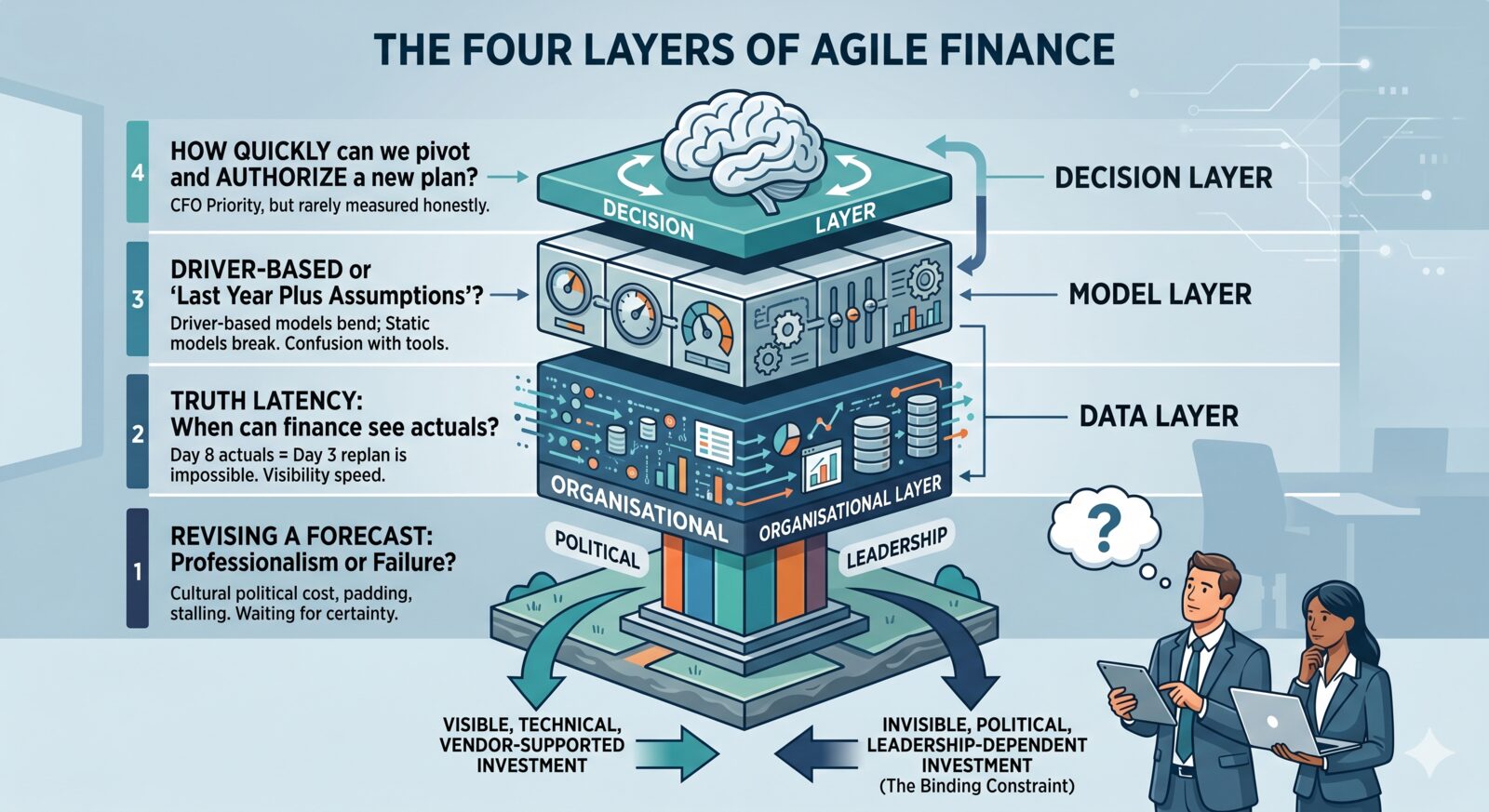
Most agile finance programmes are working on the wrong layer.
Agility in finance doesn't live in one place. It lives in four, and the layers most organisations invest in are not the layers actually holding them back.
The four layers
The decision layer
How long between recognising the world has changed and a new plan becoming authoritative. The layer CFOs say they care about, and few measure honestly.
The model layer
Are your planning models driver-based, or essentially "last year plus assumptions"? Driver-based models bend; static models break and have to be rebuilt. Most functions are deeply non-agile here and don't realise it, because they confuse having a planning tool with having a planning model.
The data layer
The truth latency between something happening in the business and finance being able to see it. If actuals land on day 8, you cannot replan on day 3. Full stop.
The organisational layer
Is finance changing its mind treated as professionalism, or as failure? Where revising a forecast carries political cost, analysts pad, stall, and wait for a certainty that never comes.
Where the money goes
The pattern we see across engagements is consistent.
What gets the budget
The data and model layers: visible, technical, vendor-supported. The parts you can buy.
What actually binds
The decision and organisational layers: invisible, political, leadership-dependent. The parts you can't.
The result: a finance function with beautiful pipelines, modern tooling, and a planning cycle that still takes six weeks, because nobody is allowed to commit to a number until everyone has agreed.
You cannot buy your way out of the organisational layer.
The binding constraint
Which of the four is your binding constraint? In our experience, the answer surprises most CFOs.
Agility across all four
Driver-based models that bend, truth latency measured in hours not days, and a decision cycle that can actually commit. Novi is built for the layers you can change, and honest about the one you can't buy. Join early access to follow the series and the work.