Econometrics vs. FP&A
They share a toolkit and a serious quantitative streak, but one looks backward and can be falsified, while the other steers a living business and rarely is. The quiet confusion between them is shaping a wave of "AI for FP&A" that will mostly disappoint.
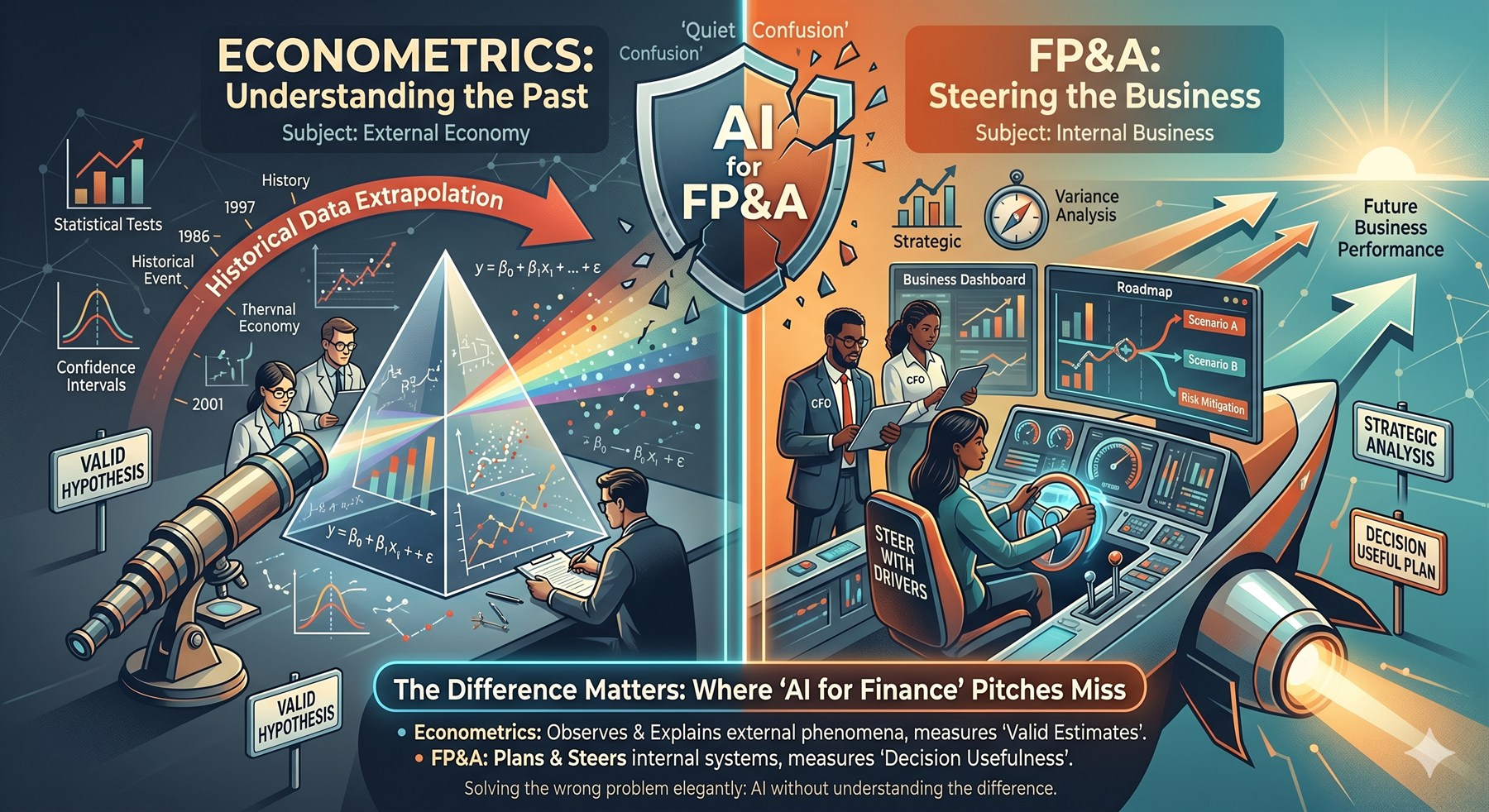
This is genuinely underexplored territory: the difference between econometrics and FP&A.
You rarely see the two disciplines placed side by side, let alone confronted. They share a toolkit (regression, time series, elasticities, driver analysis) and they're practised by quantitatively serious people who produce numbers about the future. On the surface, cousins.
But they answer different questions. And the quiet confusion between them is shaping a wave of "AI for FP&A" products that will mostly disappoint.
Backwards vs. forwards
Econometrics looks backwards
Even when it forecasts, it extrapolates estimated structure from historical data. Its subject is the economy as an external phenomenon: something to be understood, not steered. Success is measured in unbiased estimates and valid confidence intervals. The model is a hypothesis about reality.
FP&A looks forwards
Its subject is the business itself: a system being actively managed, committed to, and steered. Success is measured in decision usefulness: did the model help the CFO choose between A and B, did the variance trigger the right conversation, did the forecast hold long enough to plan against.
A deeper asymmetry
There's a deeper asymmetry. An econometric model can be falsified. An FP&A model rarely is. When the forecast misses, we don't say the model was wrong. We say the business underperformed. The FP&A model is closer to a plan than a hypothesis.
When the forecast misses, we don't say the model was wrong. We say the business underperformed.
Why "AI for finance" misses
This is why most "AI for finance" pitches miss the mark. Dropping a forecasting library into an EPM tool doesn't make it better at FP&A. The core artefact of FP&A isn't the forecast. It's the driver-based model the business commits to and steers with. That's a management object, not a statistical one.
The tools overlap. The disciplines don't.
And any tooling that doesn't understand the difference will keep solving the wrong problem, elegantly.
Tooling that knows the difference
A driver-based model you commit to and steer with, not a forecasting library bolted onto a spreadsheet. That's the bet we're making with Novi. Join early access to follow the work.