What self-service in EPM actually means
One of the least-defined phrases in enterprise planning, and one of the most important. A working definition of self-service in EPM, the moments from the field that expose the gap, and why it's the same architectural property that decides whether AI in finance is real analysis or just conversation.
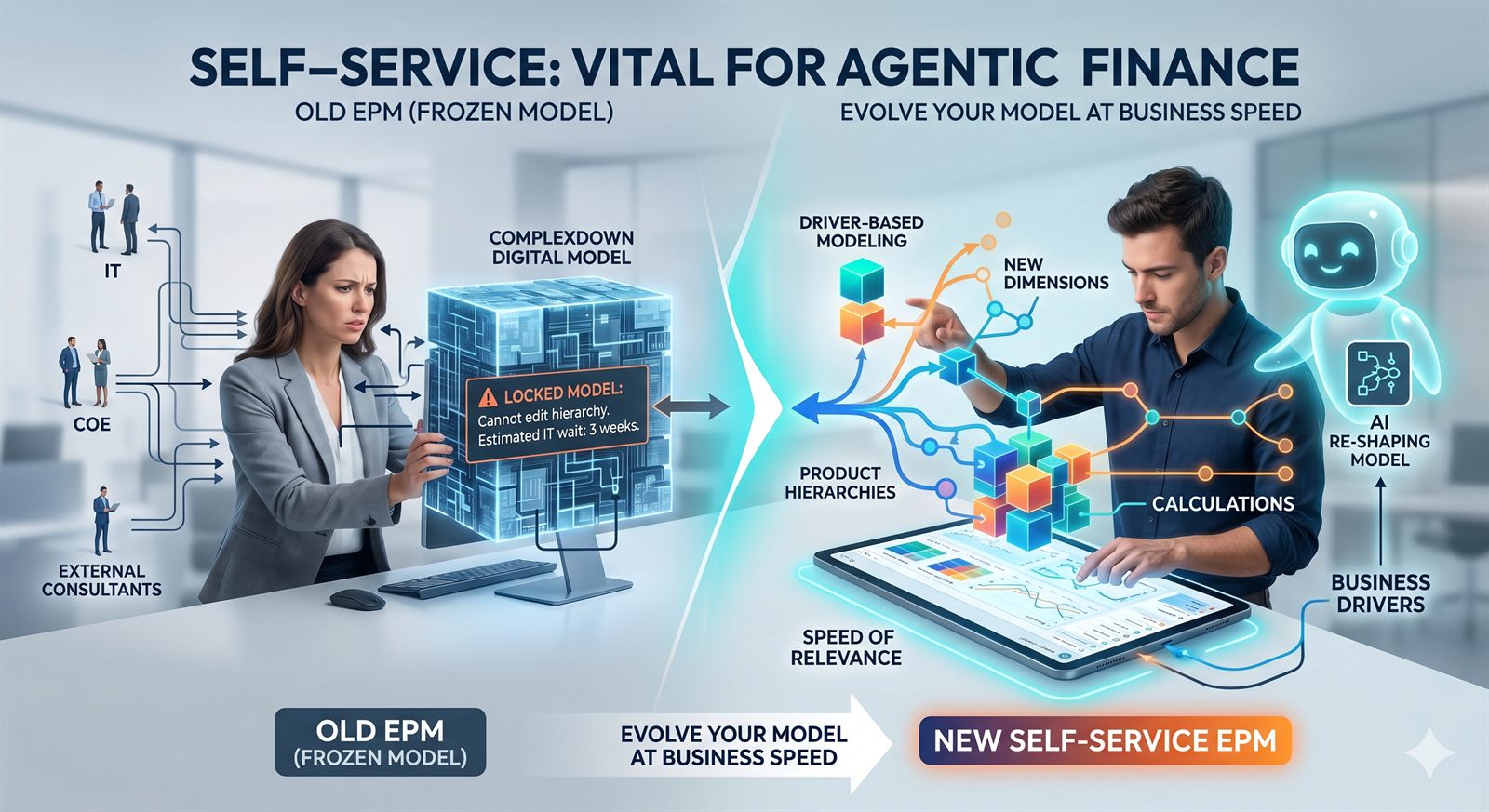
"Self-service" is one of the least-defined phrases in enterprise planning. It appears in vendor proposals, software demos and every "agile finance" transformation deck. But what does it actually mean?
A working definition
Here is the one I work from.
The ability for Finance to evolve its planning and analytical models (structure, drivers, hierarchies, calculations) at the speed the business changes, without needing IT, consultants or a Center of Excellence to translate intent into action.
Not just editing assumptions on a dashboard. Re-shaping the model itself.
Why it matters
This is the strategic component of what people call "Finance of the Future." A finance function that cannot adjust its model at the speed of the business reports yesterday's structure.
The competitive edge of FP&A is no longer in the numbers.
It's in the speed of relevance, and self-service is what makes that relevance possible.
Five moments from the field
A few moments where Finance needed self-service and felt the gap:
A mid-year acquisition
A strategic deal closes mid-year: new entity, new product hierarchy, new intercompany flows. It has to be reflected in the model before the next forecast cycle, not after the next implementation project.
One level deeper
The board asks for margin reporting one level below what the existing cube allowed. The dimension didn't exist. Adding it took a quarter.
A rolling forecast, restructured
Sudden market volatility forces a rolling-forecast restructure mid-year, with scenarios and sensitivities the original model was never built to carry.
An IAS 29 layer, in weeks
Hyperinflation in one operating region requires a separate IAS 29 calculation layer. Needed in weeks, not months.
A commodity spike, overnight
A commodity price spike had to be modelled across the P&L overnight. The team delivered. In Excel. Because the EPM couldn't.
Now layer AI on top
Every CFO is being told that AI will revolutionise FP&A. But AI on a platform that can't re-shape itself is a chatbot wired to a frozen model.
On a non-self-service platform, the intelligence accelerates the conversation, not the analysis. Real AI value in EPM requires a model that can re-shape itself in response to the question. That is the same architectural property as self-service.
The question worth sitting with
So the question worth sitting with: is real self-service in EPM achievable inside an enterprise-grade platform, or is it utopian?
And the more uncomfortable one, the one I think will define the next decade of FP&A:
Is Excel still the only system Finance has ever truly owned?
A model you can re-shape
Structure, drivers, hierarchies and calculations Finance can evolve at the speed of the business, without a ticket to IT or a new implementation project. That's the model we're building with Novi. Join early access to follow the work.