What "AI-readable" actually means
Every platform now promises your numbers are "AI-readable." Almost none say what that means. The phrase hides a small, useful truth: a model an AI can read is, very nearly, the same model a new analyst can read on their first morning. Structure, names, lineage: the checklist for a legible model.
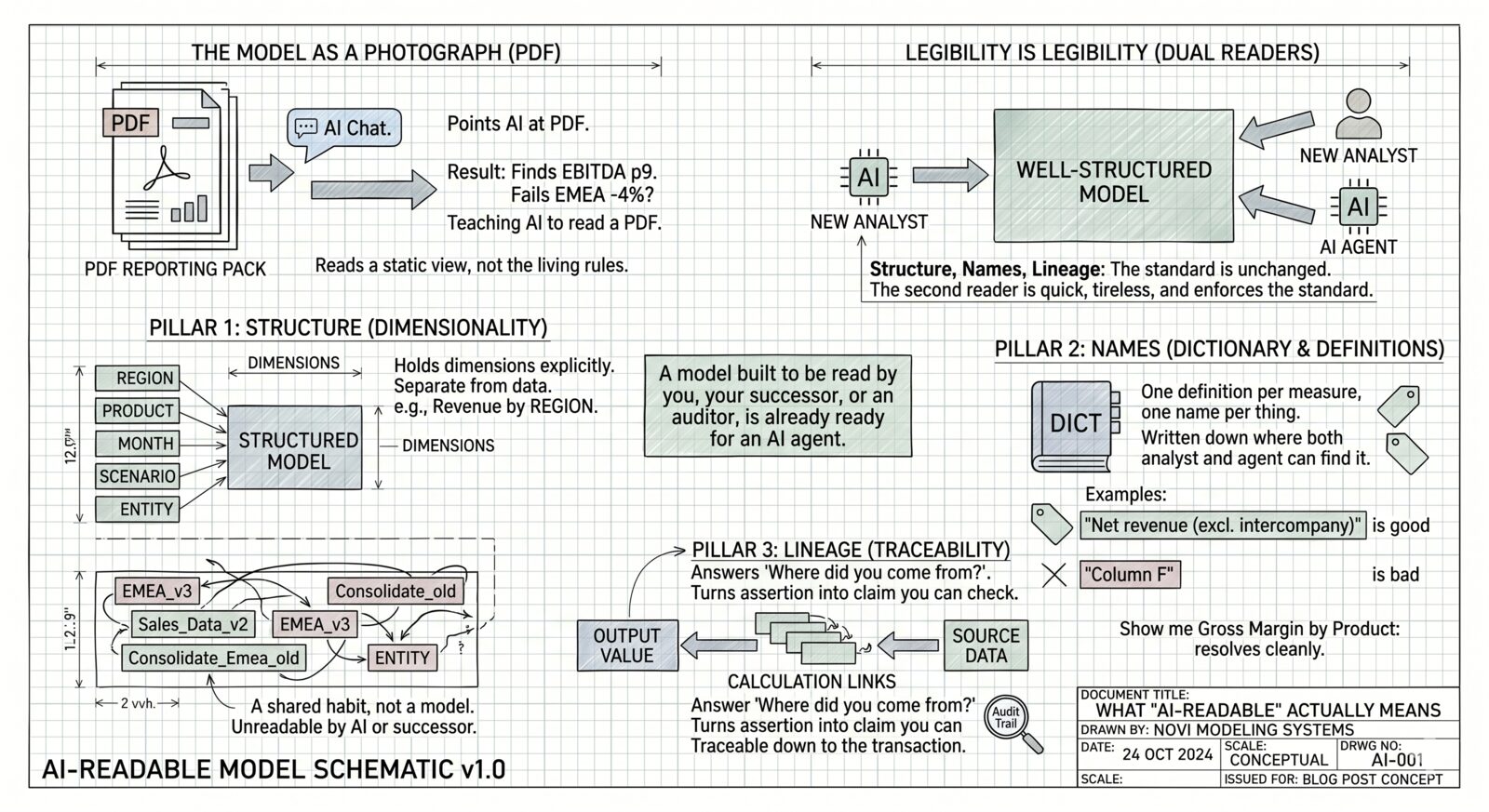
Every platform now promises that your numbers are "AI-readable." Almost none of them say what that means. It's worth pinning down, because the phrase hides a small and useful truth: a model an AI can read is, very nearly, the same model a new analyst can read on their first morning. Legibility is legibility. The machine simply has less patience for the mess.
It isn't a feature you buy
The instinct is to treat "AI-readable" as something you switch on: a chat box in the corner, a model pointed at last quarter's board pack. But pointing an AI at a PDF of your reporting pack mostly teaches it to read a PDF. It can find the EBITDA figure on page nine. It cannot tell you how that figure would move if volume fell four percent in EMEA, because the pack is a photograph of a model, not the model itself.
Readability doesn't live in the tool you point at the model. It lives in the model. And the qualities that make a model readable are neither new nor exotic. Finance has rewarded them for as long as finance has existed. There are three of them.
Structure
The model states its own shape: these are the axes I move along, named once, used everywhere.
Names
One name per thing, one definition per measure, written down where both the analyst and the agent can find it.
Lineage
Every number can answer where did you come from?, traced back to the source figure it rests on.
Structure
A model has structure when it knows what it varies by. Region, product, month, scenario, entity: each is a thing the model holds explicitly, kept separate from the data sitting inside it. Ask a model like that for revenue "by region" and it knows what region is, because region is a named dimension, not an accident of which tab you happened to open.
Compare the workbook where "region" exists only as the implied meaning of a sheet called EMEA_v3, alongside a slightly different EMEA on the consolidation tab, and a third one someone pasted in from the sales file. There is no region in that model. There's a habit, shared by the four people who know not to touch it. A machine can't read a habit. Neither, frankly, can the fifth person.
Structure is the model stating its own shape: these are the axes I move along, named once, used everywhere.
Names
Then the things in the model have to be called what they are, consistently, in the open. A measure named Net revenue (excl. intercompany) carries its own meaning. A column named F carries none; it relies on you remembering, or on a comment three cells up that someone deleted in March.
Names are the line between data and meaning. "EMEA," "Emea," and "Europe/ME" are three strings to a person willing to squint and one region to nobody. The discipline is unglamorous: one name per thing, one definition per measure, written down where both the analyst and the agent can find it. Do that, and a question like show me gross margin by product resolves cleanly, because the model and the person asking agree on what gross margin and product mean. Skip it, and every answer arrives with an asterisk.
Lineage
The third quality is the one auditors have always cared about: every number can answer the question where did you come from? You walk it back through the calculation, back through the links, back to the source figure it ultimately rests on.
Lineage is what turns a number from an assertion into a claim you can check. It is also what makes a number safe to act on when an agent assembled it in four seconds while you were getting coffee. Without lineage, a fast answer and a wrong answer look identical right up until the board meeting. With it, you trace the path, find the broken link, and fix it: the same move you'd make if a junior had handed you the number, only quicker.
A model you can hand to a new hire is a model you can hand to an agent. And when an AI can't make sense of your model, that's usually the model talking.
The same property, two readers
This is the part worth sitting with. Structure, names, lineage: these aren't a tax finance pays so the machines can join in. They are the qualities that already separate a model someone can inherit from one that retires the day its author leaves. The arrival of a second reader (quick, tireless, and entirely unmoved by everyone here just knows that) doesn't change the standard. It enforces it.
Which is quietly good news. You don't make a model AI-readable by buying AI. You make it AI-readable by building it well, and you were going to want it built well anyway, the first time you tried to hand it to someone new.
The checklist
So, concretely. Score the model in front of you, the one you actually plan in, which for most of us is a spreadsheet or a tool someone inherited. None of these questions mentions AI. Several are designed to sting.
- Can you name every dimension the model varies by (region, product, time, scenario, entity) without opening a tab to check?
- Is each of those dimensions held once and reused, rather than re-typed on every sheet?
- Does each measure have exactly one definition, written down, that everyone actually uses?
- Are member names identical everywhere they appear: no EMEA / Emea / Europe-ME drift?
- Can you trace any output number back to its inputs in a few steps, without archaeology?
- Is the structure of the model separate from its data, or baked into cell positions and tab order?
- Could someone who didn't build it understand it without you in the room?
- When a number looks wrong, can you find why, not just that?
If your model trips on three or four of these, that isn't a mark against your care or your competence. It's a mark against the medium. A spreadsheet makes every one of these failures the path of least resistance: tabs invite misnaming, cells invite hidden structure, and nothing stops the same dimension being re-typed forty times. You can hold the line against all of it (plenty of excellent modellers do, for years) but you are working against the grain, and the grain is patient.
Two ways to get there
So there are two ways to end up with a model that reads cleanly. You can hold the standard by hand: sheet after sheet, version after version, discipline against the grain. Or you can work in a medium where most of these questions simply don't apply, because the thing they test for can't go wrong in the first place.
By hand
Hold the standard yourself: every sheet, every version, discipline against a medium that resists it. Plenty of excellent modellers do, for years.
By the medium
Work where the failures can't happen: no tab to misname, dimensions held once, lineage that's just there. Most of the checklist quietly disappears.
That's the bias behind this piece, and I'd rather be plain about it than pretend to neutrality: the second way is how Novi is built. Read the checklist again with Novi in mind and most of it quietly disappears. There is no tab to misname, so structure can't hide in tab order. Dimensions are held once and reused. Re-typing one on every sheet isn't a discipline you keep, it's a thing you can't do. Lineage isn't a report you switch on; the model is assembled from links you can see, traceable down to the transaction, so the path is always there. There is no column F to forget the meaning of.
One line survives. You can still name a dimension poorly. Naming is a human judgement, and it should stay one. But you can't end up with three spellings of it by accident, because the name lives once, in the dictionary. So for a model built this way the whole checklist collapses to a single honest instruction: name things well. The rest were never really your discipline to keep. They were the medium's to lose.
So
"AI-readable," then, is mostly a new name for an old virtue. The structure you can see. The names you can trust. The path you can trace. Finance has always rewarded these, usually under deadline, usually noticed only in their absence. The machine just made them legible as a category, and a little harder to skip.
The reassuring part is the one rarely mentioned by anyone selling an AI feature. You don't get there by buying AI. You get there one of two ways: by holding these standards yourself, for years, against a medium that resists them, or by working somewhere they hold on their own. Either way, yes, you can.
The only real question is how much of it you'd rather not have to do by hand.
A model where the checklist collapses
No tab to misname, dimensions held once, lineage that's simply there, so the whole legibility checklist comes down to a single instruction: name things well. That's the medium we're building with Novi. Join early access to follow the work.