Whose model can the AI actually read?
Every EPM vendor is racing to bolt AI on top: copilots, natural-language formulas, chat-with-your-dashboard. It's a sideshow. Hand an agent the keys to a real tenant and the only question that matters is whether it can tell what's real. AI-legible, not AI-enhanced.
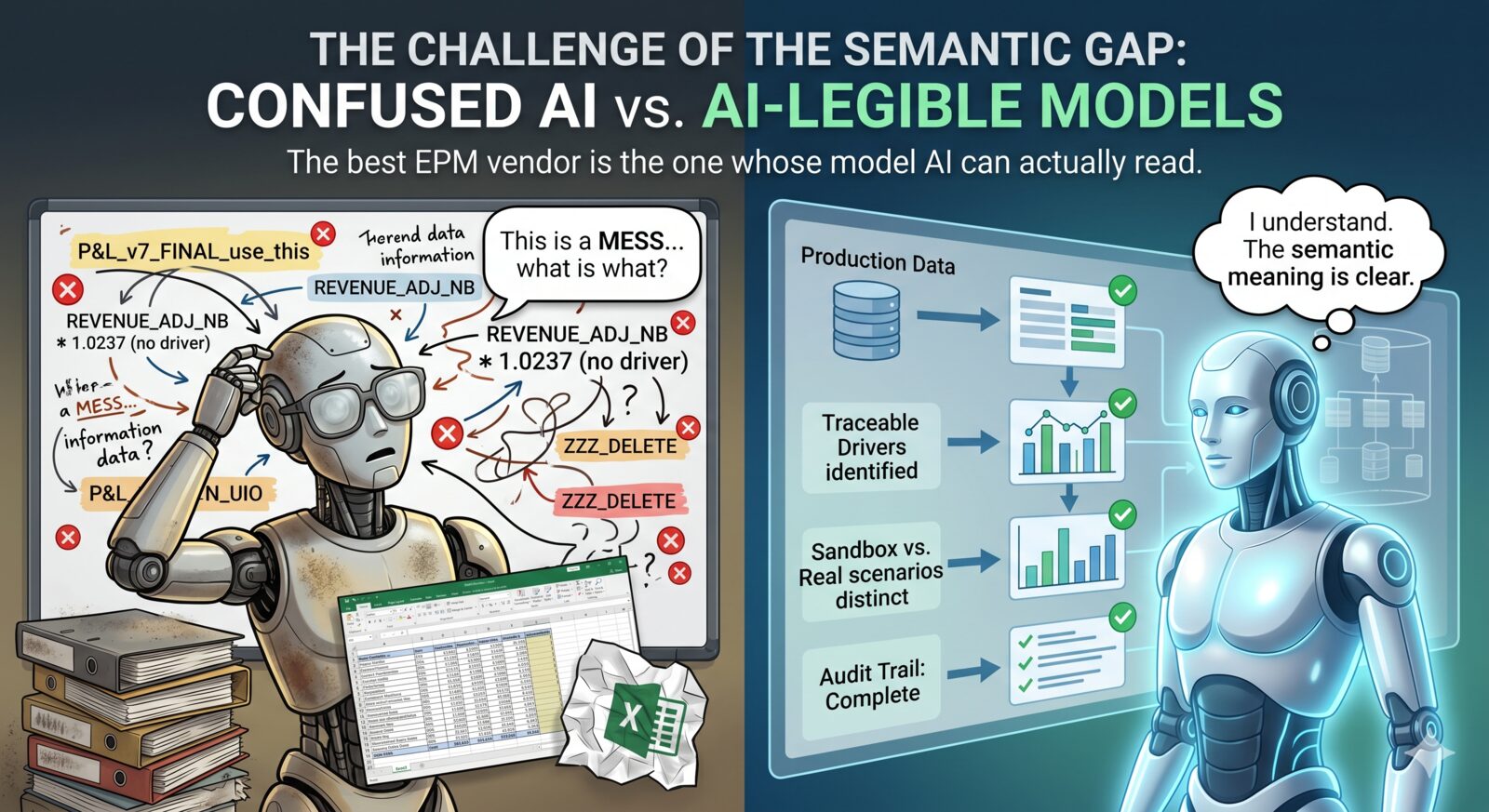
Which EPM vendor has better AI? It's the wrong question, and answering it is how a finance team ends up trusting a machine that is fluent, confident, and completely wrong.
Hand an agent the keys
Give an AI agent the keys to a real EPM tenant. What does it actually see?
- Fourteen P&L modules: which one is the P&L?
- A line item called
Revenue_Adj_NB. An adjustment? Or Nathan's bonus? - A formula multiplying by
1.0237with no comment and no driver: a real assumption, or a 2022 FX rebase nobody dares remove? - Three "dummy" line items that exist only to break circular references.
- Forty-seven cost centres tagged
ZZZ_DELETE, still wired into live formulas. - Scenarios named Budget, F1, F2, and
P&L_v7_FINAL_use_this. - An Excel file uploaded every month that everyone on the team knows holds the real forecast.
The AI will confidently summarise all of it. Average across incompatible scenarios. Report test data as fact. Treat plugs as drivers.
It will sound brilliant, and it will be wrong.
Not because the AI is dumb. Because the model was built for humans who carry the meaning in their heads: which line items to ignore, which scenarios are governed, which numbers are real and which are scaffolding.
The race is a sideshow
Every EPM vendor is now racing to bolt AI on top: copilots, natural-language formula authoring, chat-with-your-dashboard. The race is a sideshow.
The question isn't whose AI is better. It's whose model the AI can actually read.
Five questions for any vendor
Five questions worth asking anyone pitching AI for FP&A:
Production or sandbox?
Can the AI tell what's production and what's a sandbox, automatically, not by reading a naming convention?
Driver or plug?
Can it distinguish a driver from a plug, an input from an override, a memo line from a reportable account?
Why did the number move?
Can it explain why a number moved (Volume × Price × Mix, decomposed structurally) or only describe what changed?
Full lineage?
Can it trace any cell back through every transformation to source, with who touched it and when?
Reportable or just computed?
Can it tell you whether a number is reportable under your accounting policies, or just compute it?
And if the agent is allowed not just to summarise what it sees but to build, verify, recalculate and simulate, does it do all of that in an isolated sandbox?
It can't be retrofitted
Most current EPM platforms fail at least three of these, structurally. They can ship copilots tomorrow; that part is easy. What they can't do is retrofit semantic meaning into thousands of customer models built for a decade without those concepts.
That's not a feature gap. It's a different product.
AI-legible, not AI-enhanced
The next generation of EPM isn't AI-enhanced.
It's AI-legible, built so the agent can tell what's real.
That's the only AI question worth asking your vendor.
Built AI-legible
A model where production and sandbox, drivers and plugs, reportable and computed are structural facts the agent can read, not conventions kept in someone's head. That's what we're building with Novi. Join early access to follow the work.