Why 13 weeks?
It’s the most oddly specific number in finance: not a quarter, not three months, not ninety days, but exactly thirteen weeks. Everyone in treasury and turnaround uses it, almost nobody questions it. Here’s the logic behind the standard cash horizon.

It’s the most oddly specific number in finance. Not a quarter, not three months, not ninety days: thirteen weeks. Everyone in treasury and turnaround uses it, almost nobody questions it, and the precision is doing more work than it looks.
Ask why the standard cash horizon is thirteen weeks and the usual answer is a shrug: “it’s just what people do.” But the number isn’t arbitrary, and it isn’t a round-number compromise either. It’s a choice that quietly encodes a whole philosophy about when you can see trouble coming and how finely you need to watch the bank balance to act in time. Worth pulling apart.
Where the number comes from
The 13-week cash flow forecast (TWCF, if you want the acronym) didn’t come out of textbook FP&A. It came out of the turnaround and restructuring world, where the question isn’t “what will profit be next year?” but the far blunter “will there be money in the account on Friday to make payroll?”
In a distressed company, the income statement stops being the thing that matters. A business can be profitable on paper and still die because cash arrives too late to cover what’s already due. So the restructuring advisors who specialise in these situations, the names that show up when a company is in trouble, standardised a tool built for exactly that question: a weekly, cash-in-minus-cash-out forecast running one quarter ahead.
It hardened into a standard because lenders started requiring it. When a distressed company needs financing to survive (debtor-in-possession financing in a US Chapter 11, or simply a nervous bank deciding whether to extend its line) the price of that money is visibility. The lender wants to see, week by week, that the business can make it to the other side. A credible 13-week forecast became the cost of admission. One 2024 survey of major restructurings found that nearly half made delivery of a 13-week forecast an explicit condition of the financing. What began as a turnaround technique is now the recognised language of short-term liquidity, and the format banks and investors expect on sight.
Why thirteen, and not twelve or fourteen
Here’s the quiet elegance: a quarter is thirteen weeks. Fifty-two weeks divided by four is exactly thirteen, no remainder, no rounding. So “thirteen weeks” is really “one quarter, counted in weeks instead of months.” It lines up cleanly with the reporting cycle every business already runs on, which is no accident.
It’s the same arithmetic that underpins the 4-4-5 calendar retailers and many others run on: a quarter carved into “months” of four, four, and five weeks: 4 + 4 + 5 = thirteen. That convention exists precisely so a fiscal month is a whole number of weeks, every period closes on the same weekday, and like-for-like comparisons aren’t thrown off by a month having four Saturdays one year and five the next. A business already on a 4-4-5 calendar gets a bonus: the cash horizon and the reporting quarter are literally the same span, week for week. The thirteen-week forecast maps straight onto the books with nothing to reconcile.
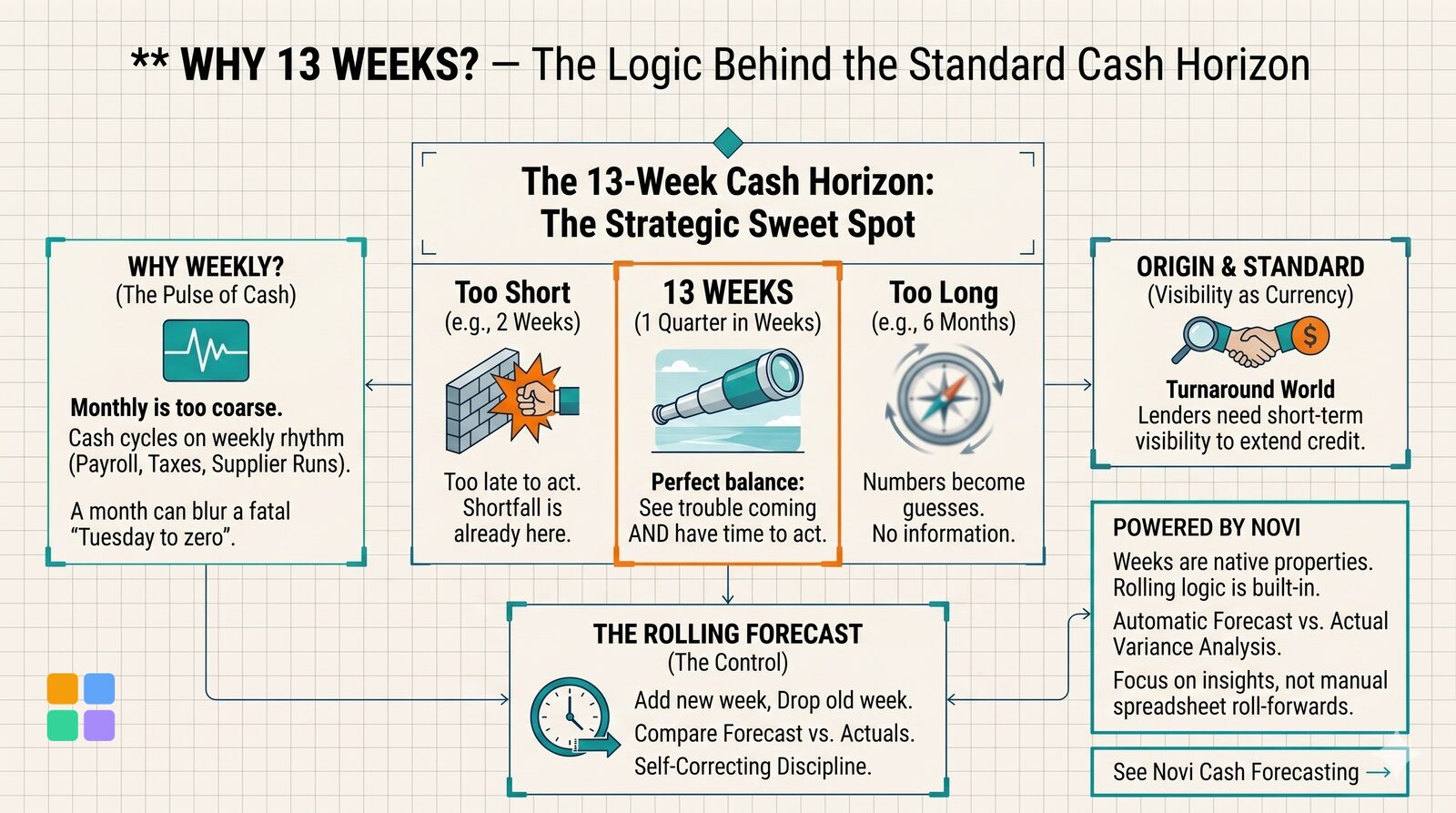
But the deeper reason is that thirteen weeks sits on a sweet spot between two failures:
Too short to act
If you can only see two weeks ahead, a shortfall is already on top of you by the time it appears. There’s no runway to draw down a facility, chase a big receivable, or stretch a payment. You see the wall the week you hit it.
Too long to trust
Push the weekly horizon out to six months or a year and the later weeks become fiction, confident-looking cells nobody can actually defend, because no one knows which customer pays in week 34.
Thirteen weeks is the span where both pressures relax at once. It’s far enough to see trouble coming with time to do something about it, and near enough that the numbers are still real. That balance, not the arithmetic of the quarter, is why the number stuck.
Thirteen weeks is a rolling quarter ahead: long enough to arrange financing before a shortfall arrives, short enough that every week is still forecastable rather than guessed. The horizon is the message. It’s exactly the distance at which you can still act.
Why weekly, and not monthly
The other half of the choice is the grain. A normal plan runs in months; a cash forecast runs in weeks, and in a liquidity squeeze, that difference is everything.
Monthly is too coarse to survive a cash crisis, because the things that sink a company don’t respect month boundaries. Payroll lands on specific days. A tax payment is due on the 15th. A large supplier run clears all at once. A month that nets out positive can still contain a week where the account goes to zero on Tuesday, and “zero on Tuesday” is fatal regardless of how the month ends. Average a cash dip across thirty days and it vanishes from view precisely when you most need to see it.
There’s a deeper reason than just “months are too lumpy,” though: cash genuinely cycles on a weekly rhythm. So much of what moves the bank balance repeats on a seven-day beat: payroll runs weekly or fortnightly, supplier payment runs go out on a set day, collections cluster by day of the week, and the weekend is a recurring two-day gap where money stops moving entirely. Forecast in the unit the cash actually flows in and the pattern becomes legible; average it into months and you blur out the very rhythm you’re trying to manage.
Cash isn’t smooth; it pulses, and the period of the pulse is roughly the week.
That’s why the week is the resolution at which cash actually behaves. It’s fine enough to catch the timing (the gap between when money goes out and when it comes in) and coarse enough that a human can maintain it every week without it becoming a second job. Daily would be finer still, but most businesses can’t forecast a specific day’s collections with any honesty, and the upkeep would swamp the benefit. Weekly is where detail and discipline meet.
Why it rolls
A 13-week forecast isn’t built once and filed. Each week, the oldest week drops off, a new thirteenth week is added at the far end, and, the part that earns its keep, last week’s forecast is compared against what actually happened. The horizon stays a constant quarter ahead no matter when you look at it.
That weekly comparison is the real engine. The gap between what you predicted and what landed, the variance, tells you whether your assumptions about collections, timing, and spend are holding, and lets you correct them while there’s still room to act. A 13-week forecast that never gets reconciled against actuals is just a spreadsheet of hopes. The rolling, self-correcting rhythm is what makes it a control rather than a guess.
In Novi, the horizon is a property, not a rebuild
In a spreadsheet, a rolling 13-week forecast is a manual ritual: shift the columns, re-point the formulas, paste in the actuals, hope nothing broke in the move. The structure fights you every week, and the weekly reconciliation that gives the tool its value is the first thing to get skipped when things are busy, which is exactly when it matters most.
In Novi, weeks are a real grain on the time dimension, and the rolling horizon is a property of the model rather than a layout you maintain by hand. The forecast advances on its own, last week’s prediction sits beside what actually happened, and the variance that tells you whether you’re on track writes itself. The discipline the 13-week forecast demands stops depending on whoever remembers to drag the columns, which is the whole point of giving cash this much attention in the first place.
Thirteen weeks isn’t a round number. It’s a deliberate one. It’s a quarter counted in weeks, born in the turnaround world where the only question that matters is whether cash will be there on Friday, and hardened into a standard because lenders now demand it as the price of financing. The horizon is chosen to be far enough to act before a shortfall hits but near enough that the numbers stay real.
The weekly grain is chosen because cash crises don’t respect month boundaries. Payroll, taxes, and supplier runs land on days, not in averages. And it rolls, reconciling forecast against actuals every week, because a cash forecast you never check is just a list of hopes. The specificity is the point: it’s the exact distance, at the exact resolution, where you can still see trouble and do something about it.
Give cash a horizon that maintains itself
In Novi, weeks are a real grain on the time dimension and the rolling 13-week forecast is a property of the model. It advances on its own, last week’s prediction sits beside what landed, and the variance writes itself.