Zero-based budgeting
The most-promised, least-understood idea in budgeting: build every budget from nothing, justify every line, inherit no number. Here’s what it actually delivers once the consulting gloss wears off.
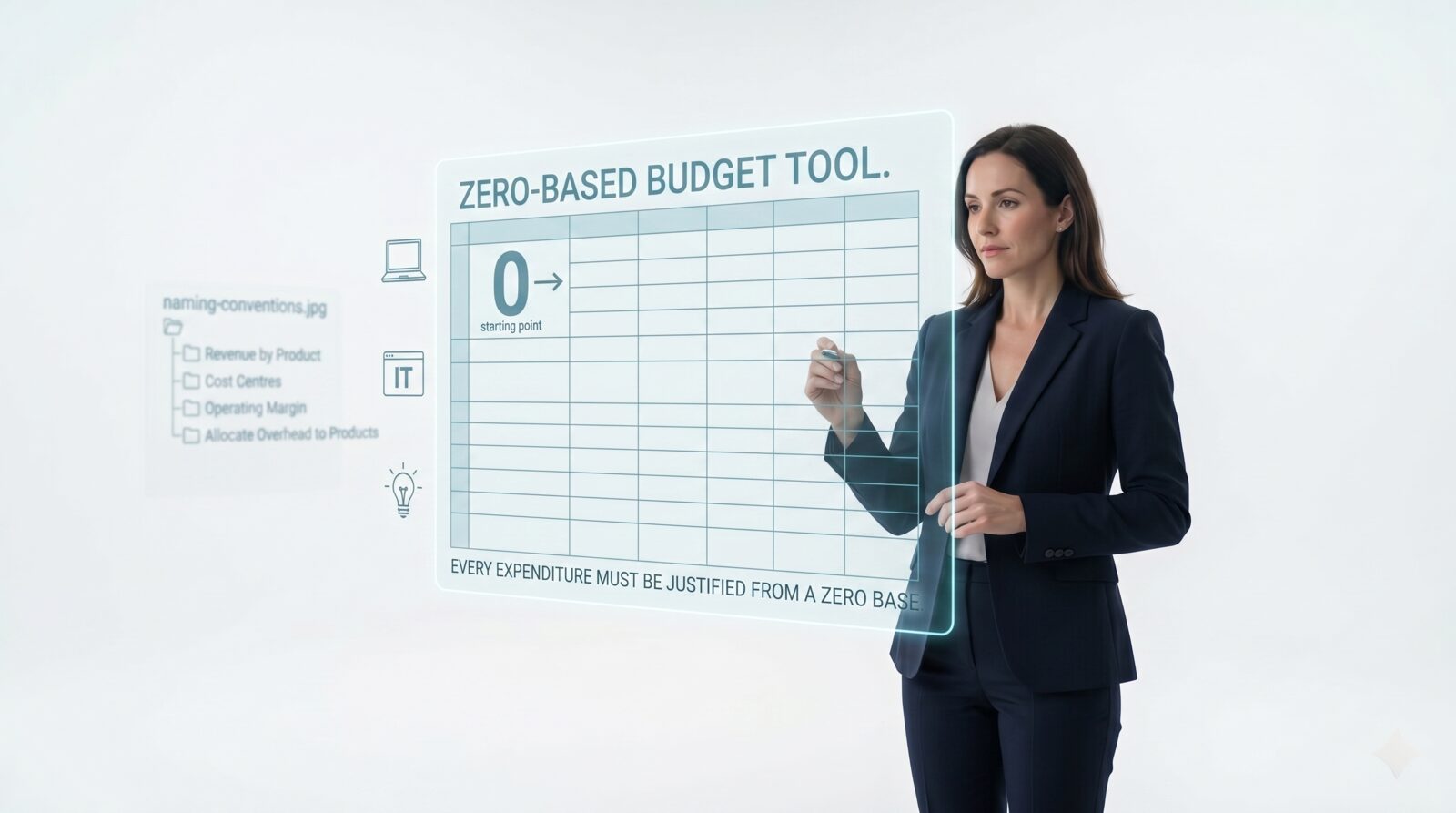
Few finance ideas arrive with as much shine as zero-based budgeting. It promises something that sounds unarguable: stop rolling last year’s numbers forward by a few percent, start every budget from a blank page, and make every cost earn its place. Put like that, who could be against it? And yet for fifty years ZBB has followed the same arc: rediscovered, evangelised, rolled out at enormous effort, and then quietly abandoned a year or two later. That pattern is the most interesting thing about it, and the part the brochures leave out.
This is the honest version. We’ll define what ZBB actually is, trace why it was invented and what problem it was genuinely solving, look at the cases where it earns its keep, and the ones where it quietly destroys value, and lay out the pitfalls that sink most implementations. The aim isn’t to sell it or bury it. It’s to leave you able to tell, for your own organisation, whether it’s the right tool or just the fashionable one.
What zero-based budgeting actually is
Zero-based budgeting is a method in which every budget is rebuilt from a base of zero each cycle. No line is carried forward by default; every expense must be justified from scratch, as if the activity were being funded for the first time.
The contrast that defines it is with the thing almost everyone actually does: incremental budgeting. In the incremental world, last year’s budget is the starting point. You take the prior number, adjust for inflation, growth, a known new hire or two, and the bulk of the budget is settled before anyone has asked whether the underlying spend still makes sense. The default is continuation. You argue about the change, not the base.
ZBB inverts that default. There is no base. The marketing team doesn’t start from “last year plus 4%”. It starts from nothing and has to build the case for every programme it wants funded. The question stops being “how much more than last year?” and becomes “does this spend deserve to exist at all, and at what level?”
The mechanism that makes this tractable is the decision package. Rather than budgeting line by line in the abstract, managers describe each activity as a self-contained unit: what it’s for, what it costs, what it delivers, and, crucially, what happens at different funding levels. A decision package for a support function might describe the minimum viable version, the current version, and an enhanced version, each with its own cost and consequence. Leadership then ranks the packages across the whole organisation and funds down the list until the money runs out. Spending stops being a set of departmental entitlements and becomes a single prioritised queue.
ZBB forces every activity in the company to compete for the same pool of money, on stated merits, rather than each defending its own historical slice.
That ranking step is the real heart of it. ZBB isn’t only about scrutiny. It’s about making spend earn its place against every other claim on the budget, not just against its own past.
Why it was invented
ZBB was a solution to a specific, real, and still-familiar disease: budgetary slack.
When every budget starts from last year’s, costs become sticky in a particular way. A programme funded for a good reason in 2019 keeps getting funded in 2024, not because anyone re-decided it was worthwhile, but because it was in the base, and the base is what nobody argues about. Low-priority activities survive indefinitely simply by never being re-examined. Inefficiency compounds quietly, one untouched line at a time. The incremental process is structurally biased toward yesterday’s priorities, because it only ever debates the increment.
The man who named the cure was Peter Pyhrr, a manager at Texas Instruments. In the late 1960s he built a process to make every activity justify itself from zero, and ran it across the company’s staff and research divisions to prove it could work at scale. In 1970 he wrote it up in the Harvard Business Review, and the idea escaped into the world.
It escaped fast. Jimmy Carter, then Governor of Georgia, read the article and put ZBB to work in the state’s government; when he reached the White House later in the decade he pushed it onto the federal budget. For a while in the 1970s, zero-based budgeting was the reform: the technique that would finally drag public spending back to first principles.
The problem ZBB was built for is real and hasn’t gone anywhere: budgets that carry yesterday’s decisions forward unexamined, because the base is the one thing the process never questions. Every revival of ZBB is really a rediscovery of that problem.
Hold onto that, because it matters for the honest assessment. The disease is genuine. The question is only whether this particular cure is worth its side effects, and whether you have to take the full dose to get the benefit.
The second life, and the cautionary tale
ZBB never fully died, but it came roaring back in the 2010s, this time wearing a sharp suit. Its champion was 3G Capital, the Brazilian investment firm, which made relentless zero-based cost discipline the centrepiece of how it ran the consumer-goods businesses it acquired. ZBB became a consulting product: packaged, sold, and rolled out as a transformation programme. This is the “consulting gloss” the title means: ZBB repositioned from a budgeting technique into a promise of permanent, dramatic cost reduction.
The most-studied result is Kraft Heinz, formed by a 3G-backed merger in 2015. The cost machine worked exactly as advertised at first. Margins jumped, costs fell. And then the bill came due. Marketing spend was squeezed to roughly half the level of peers. Brand-building, research, and innovation (the things that don’t show a return this quarter) were starved. Package sizes shrank. And a few years on, in early 2019, the company took a $15.4 billion writedown against the value of its best-known brands and watched its market value fall by more than half.
The lesson isn’t that ZBB is a fraud. It’s narrower and more useful: a method built to question every cost is dangerous in the hands of people who only want the costs to go down. Cutting and prioritising are not the same act. ZBB is a prioritisation discipline that can be used to cut, but pointed at a brand-driven business with a mandate to reduce spend every year, it will happily eat the seed corn.
You can’t cut costs forever. There’s a floor, and ZBB will find it whether or not the floor is where value lives.
So the honest reading has two halves. ZBB is a legitimate, sometimes powerful way to reallocate money toward what matters. It is also the favourite instrument of value-destroying cost crusades. Which one you get depends entirely on the intent behind it, and that’s a management choice, not a property of the method.
When it actually fits
ZBB is a heavy instrument. Used everywhere, all the time, it collapses under its own administrative weight. Used in the right place, at the right moment, it does something no incremental process can. The skill is knowing which situation you’re in.
Where it earns its keep
The base is genuinely suspect. After years of incremental budgeting, a few acquisitions, or a reorg that never cleaned up, there’s accumulated slack nobody can see and nobody will surface by arguing about increments. ZBB is built precisely to flush that out.
You’re targeting controllable, repeatable spend. SG&A, overhead, indirect procurement, marketing programmes, travel, professional services: costs where the question “do we still need this, at this level?” has a real answer. This is ZBB’s home turf.
There’s a real reallocation to make, not just a cut to take. The technique earns its cost when the goal is to move money from low-value activities to high-value ones: to fund the new bet by retiring the stale programme.
Leadership will actually sponsor it. ZBB upends long-standing assumptions about who owns which budget. Without visible, sustained sponsorship it becomes a paperwork exercise everyone games.
Where it backfires
You’d apply it to everything, every year, by reflex. The full ceremony across the whole P&L annually is rarely worth it. Most organisations get the benefit from targeting specific cost categories, and from running the deep exercise periodically, rather than every cycle.
The spend is strategic and long-horizon. R&D, brand, platform investment, culture (anything whose payoff is years out) is exactly what an annual “justify it from zero” cycle punishes, because its return never fits inside the budget window.
You’re small or fast-moving. A startup chasing opportunities, or a team without the tools and people to run the process properly, will find ZBB’s overhead buys an agility-loss it can’t afford.
A useful reframing the better practitioners have landed on: ZBB is less an annual budgeting system than a periodic cost-structure reset, a way to rebuild your understanding of where the money goes and force a re-prioritisation, after which lighter-weight processes keep it honest.
What it gives you, and what it costs
Strip away the advocacy and the criticism, and the trade is fairly clear.
| What ZBB gives you | What it costs you |
|---|---|
| Visibility. You learn where the money actually goes, at a granularity incremental budgeting never forces. | Time and effort. Rebuilding budgets from zero is enormously more work than adjusting last year’s: heavy on managers, finance, and approval cycles. |
| A killed-slack reset. Legacy spend that survived only by being in the base finally gets re-examined. | Short-termism. The “justify it this cycle” frame structurally disfavours long-horizon spend (R&D, brand, capability) whose return doesn’t land inside the window. |
| Genuine reallocation. Money can move toward priorities instead of ossifying by department. | Organisational friction. It threatens incumbents and overturns budget ownership; resistance and gaming are the default response, not the exception. |
| Cost ownership. Forcing managers to defend every line builds real accountability for spend. | Fade. Done as a one-off project, the savings erode and the base creeps back within a year or two unless the mindset sticks. |
| Documented savings. Well-run programmes have reported double-digit savings in targeted categories. | Capability for capture. The same machinery makes it the perfect cover for value-destroying cuts when leadership’s real goal is just “spend less.” |
Notice the symmetry: almost every benefit has a shadow. Visibility costs effort. The slack reset risks cutting muscle with the fat. The accountability breeds friction. ZBB doesn’t have a free lunch hidden in it. It has a real trade, and the trade is only worth making when the slack is genuinely there and the intent is genuinely reallocation.
The pitfalls that matter most
If you take one thing from the practitioner literature, take this: most ZBB programmes don’t fail at the analysis. They fail at the follow-through and the framing. Four pitfalls account for most of the wreckage.
Treating it as a cost-cutting project instead of a way of operating
This is the big one. Organisations run the exercise once, bank the savings, declare victory, and then let the base quietly reassemble itself. Within two cycles the slack is back, because nothing changed about how decisions get made; only this year’s number changed. ZBB only pays off durably when the prioritisation becomes a habit, not a one-time purge. If you’re going to do it, commit to it as a mindset or don’t bother with the overhead.
Starving the long term to flatter the short term
Because every cost has to justify itself now, the costs with deferred payoffs lose the argument every time, and they’re often the most important ones. R&D, brand investment, preventive maintenance, training, platform work: each is easy to cut in a ZBB cycle and expensive to have cut, years later. The discipline has no built-in defence for the future. You have to install one deliberately (ring-fencing strategic spend, or judging certain packages on a different horizon) or ZBB will optimise it away.
Rushing the rollout without the tooling to support it
ZBB generates a mountain of granular, bottom-up data: costs by category, by owner, by package, by funding level. Try to run that on the existing patchwork of spreadsheets and you get a process that’s slow, error-prone, and worst of all late: one medical-device maker rushed its implementation and couldn’t tell whether units had hit their savings targets until a quarter or two after the fact. By then the steering wheel isn’t connected to anything. The granularity ZBB demands is a data problem before it’s a budgeting problem.
Underestimating the human reaction
ZBB tells every manager that their budget is no longer theirs by right. That is a genuine threat, and people respond to threats: by sandbagging packages, inflating the “minimum viable” tier, or fighting the process outright. Without heavy, repeated communication about what the exercise is for (reallocation toward priorities, not a witch-hunt for cuts) the analysis gets quietly corrupted by everyone protecting their own. The technique assumes honest decision packages; the politics work against exactly that.
The pattern under all four: ZBB is easy to start and hard to sustain. The analysis is the glamorous part and the easy part. The framing, the tooling, the defence of the long term, and the discipline to keep doing it: that’s where the value is won or lost.
The honest assessment
So, after the gloss wears off, is zero-based budgeting good?
The honest answer is that it’s a sharp, narrow tool wearing the costume of a universal philosophy, and most of the disappointment comes from confusing the two.
As a tool, it’s real. The problem it attacks, slack accumulating in an unexamined base, is genuine and widespread, and nothing in incremental budgeting will surface it. Pointed at the right spend, with reallocation as the goal and the stamina to make it stick, ZBB does something valuable that the alternatives don’t: it makes every cost compete on present merit, and it moves money toward what matters.
As a philosophy (rebuild everything from zero, every year, forever) it overreaches, and the overreach is where it hurts people. The full ceremony is too expensive to run universally, the short-term frame quietly punishes the investments that build the future, and the same machinery that reallocates wisely in good hands cuts to the bone in cost-obsessed ones. The most famous ZBB story of the last decade is a cautionary one for a reason.
The synthesis the better practitioners have reached is the sane one: use ZBB as a periodic reset, on targeted spend, with a deliberate guard for the long term, not as a permanent annual ritual applied to the whole business. Get the base honest, reallocate toward priorities, then let lighter processes hold the line until the next reset. Treated that way, it’s one of the more powerful instruments in the budgeting toolkit. Treated as a religion, it’s the most expensive way ever devised to talk yourself into eating your own seed corn.
The technique isn’t the risk. The intent behind it is.
In Novi, the base is never a mystery
Most of what makes ZBB painful isn’t the idea. It’s the labour and the blindness. The exercise demands that you see every cost at line-item granularity, sliced by category and by owner, re-rankable across the whole organisation, with funding tiers you can flex and compare. On a patchwork of spreadsheets, assembling that view is the project, and by the time it’s assembled, it’s already stale.
In Novi, the cost structure is a model, not a reconstruction. Spend lives in dimensioned tables (by cost category, by owner, by activity) so the granular, multi-dimensional view ZBB requires isn’t built from scratch each cycle; it’s the shape of the data already. Slicing overhead by department, then re-slicing the same money by category, is a pivot, not a rebuild. The decision-package idea (minimum, current, enhanced) is just a scenario dimension: model the funding levels side by side, rank them, and watch the totals move as you fund down the list.
And because the base is structured and legible, the two things that sink ZBB programmes get easier. The tooling pitfall softens. You’re not waiting a quarter to learn whether units hit their targets, because the numbers are live in the model. And the short-term blindness gets a counterweight: when strategic spend is its own first-class dimension, it’s something you can ring-fence and look at deliberately, not a line that silently loses the argument because nobody could see it whole.
Novi won’t tell you whether to run ZBB. That’s a judgement about your business, and this article has tried to make it an honest one. What it removes is the excuse that the exercise is too heavy to attempt, and the trap that you cut blind. The discipline becomes about the decisions, where it belongs, not about the assembling of the spreadsheet underneath them.
Zero-based budgeting attacks a real disease, slack that accumulates in a budget base nobody re-examines, by forcing every cost to justify itself from zero and compete for funding on present merit. On targeted spend, with reallocation as the goal, it surfaces waste and moves money toward what matters.
But it’s a sharp, narrow tool sold as a universal philosophy, and the overreach is where it hurts: the full annual ceremony is too costly to run everywhere, its “justify it now” frame quietly starves long-horizon investment, and the same machinery becomes a weapon for value-destroying cuts in the wrong hands. The verdict: use it as a periodic reset on controllable spend, guard the long term deliberately, and commit to the mindset or skip the overhead. The technique isn’t the risk. The intent behind it is.
See your costs whole, without the rebuild
In Novi, spend lives in dimensioned tables you can slice, re-rank and flex by funding tier, so the granular view ZBB demands is the shape of the data already, not a quarter-long project that’s stale on arrival.